Human Quest
Weaving Tales, Selling Software
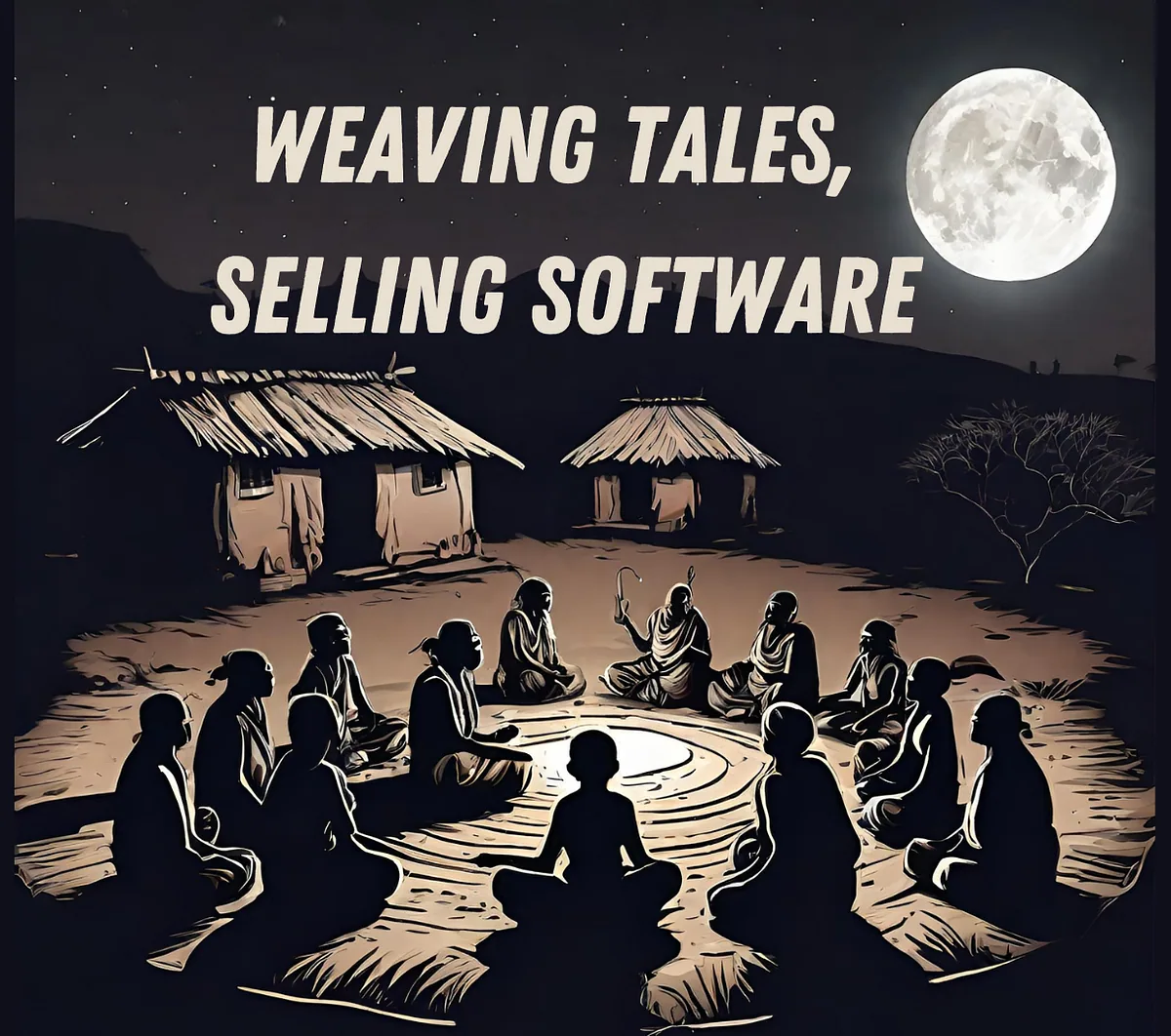
Imagine an ancient Indian village illuminated by the ethereal silver glow of the moon. As the stars begin to twinkle, the villagers gather in the communal square.
On this page
Imagine an ancient Indian village illuminated by the ethereal silver glow of the moon. As the stars begin to twinkle, the villagers gather in the communal square. Children cease their play, and adults set aside their chores. It’s a special evening, a storytelling evening, and the atmosphere is thick with anticipation.
In the center of the square sits the village storyteller, an elderly man with wise eyes and a welcoming smile. His reputation extends beyond the borders of this small village. People say that when he narrates tales from the Mahabharata, the epic comes alive, and tonight he will tell yet another enthralling chapter.
The stage is set, and the storyteller begins. With each sentence, he weaves a spell that transports the audience to the grand courts of Hastinapura, to the mystical forests of Dandaka, and to the fierce battlegrounds of Kurukshetra.
Now, fast forward a few millennia to our modern world, a world powered by technology and driven by data. Here, the communal squares have been replaced by digital platforms, and the storytellers are entrepreneurs, marketers, sellers, and product managers in the tech industry. But the essence of storytelling remains the same, engaging audiences and transporting them to different realms, sometimes to solve a business problem, sometimes to explore new opportunities.
In this post, we’ll journey through the village square and into the virtual conference rooms to explore the eternal power of storytelling.
Ancient Wisdom in Storytelling
On this magical moonlit evening, the village seems to hold its breath as the storyteller begins his tale. He knows his audience well, a mix of young and old, some seeking entertainment and others in pursuit of wisdom. He launches into the saga of the Mahabharata, a story bursting with heroism, betrayal, love, and wisdom.
The chosen chapter is Arjuna’s moment of indecision on the battlefield of Kurukshetra. The children listen intently, their eyes widening at the descriptions of Arjuna’s legendary bow, Gandiva, and the impending epic clash. The adults, however, tune into the nuanced philosophy: the sacred teachings of the Bhagavad Gita that Lord Krishna imparts to the conflicted Arjuna.
Skilled in the art of modulation, the storyteller captures the attention of both young and old. For the children, he amplifies the sensory elements, the clash of metal, the roar of chariots. For the adults, he dives into Arjuna’s ethical conundrum, weaving in themes of duty, justice, and righteousness.
As the story unfolds, the villagers can sense the emotional undertone in the storyteller’s voice, his admiration for Arjuna’s valor, his respect for Krishna’s wisdom. This emotional involvement enriches the narrative. It’s not just a tale told; it’s a story lived. The audience feels the storyteller’s connection to the epic, which in turn deepens their own emotional engagement with the story.
After narrating the intense dialogues of the Gita, the storyteller doesn’t just stop. He narrates a real-life story of a village elder who once faced a similar moral dilemma, providing a practical, relatable example that transforms an ancient moral lesson into contemporary wisdom.
With the night deepening and the moon at its zenith, the story comes to a close. But its echoes resonate within each listener, tailored to their needs, emotionally engaging, and immediately relevant to their lives.
Revisiting the Digital Campfire: A Budding B2B SaaS Startup
Let’s consider a budding B2B SaaS startup specializing in supply chain optimization. Here, the challenges are complex, involving logistical intricacies, cost management, and timely deliveries. The startup’s solution uses Artificial Intelligence to streamline operations, making the supply chain more efficient and cost-effective.
The Persona-Driven Narrative
The marketing head knows the audience is diverse, supply chain managers, CFOs, and IT specialists. The pitch kicks off with the day-to-day challenges of a supply chain manager, outlining the bottlenecks and inefficiencies they face. It then smoothly transitions to discuss the cost-saving potential and ROI, aimed at the CFOs in the room. Finally, the narrative brings in the robustness and scalability of the AI algorithms for the IT specialists.
Here, the tone and focus shift subtly yet significantly to resonate with each persona, much like how our village storyteller tailored the Mahabharata’s messages for both children and philosophers.
Emotional Investment
The marketing head has never managed a supply chain, but they’ve immersed themselves in customer interviews, studies, and feedback. They narrate a compelling customer story that encapsulates the struggles and ultimate triumph using their solution. It’s evident that they feel deeply connected to the customer’s journey, adding an emotional layer to the pitch that mere facts and figures couldn’t achieve.
Testimonials and Case Studies
As the crescendo of the pitch, the marketing head showcases a series of testimonials and case studies. These serve as modern-day fables, each recounting how the AI-driven solution revolutionized a specific aspect of supply chain management. These stories offer not just endorsement but actionable insights, a roadmap of transformation that each business in the room can relate to.
The beauty of this approach lies in its adaptability. The core tenets of storytelling have stood the test of time, from the village square to the boardroom. By drawing upon these timeless principles, we can craft narratives that engage, resonate, and most importantly, inspire action: whether it’s following a path of righteousness or optimizing a supply chain.
The Timeless Essence of Storytelling
As the digital clock on the conference room wall ticks away, marking the end of the pitch, and as the final echoes of our ancient storyteller’s words fade into the moonlit night, one thing remains abundantly clear: the power of storytelling transcends time, space, and circumstance.
Whether it’s the epic tales from the Mahabharata or a cutting-edge B2B SaaS startup or enterprise software, the fundamental principles remain consistent. Tailoring your story to resonate with your audience creates a meaningful impact, whether you’re a child enchanted by heroism or a C-suite executive considering an investment. Emotional engagement transforms your narrative from a mere sequence of events into an experience that leaves a lasting impression. Finally, grounding your story with real-world examples or testimonials provides actionable wisdom that elevates the narrative from being merely instructive to genuinely transformative.
For Modern Tech Storytellers
For modern tech storytellers, the lessons are clear. Understand your audience intimately and customize your message to resonate with them. Immerse yourself emotionally in the problem your product is solving, even if you haven’t experienced it personally. Use real-world testimonials and case studies as your modern-day fables, offering not just an endorsement but a path to transformation.
By incorporating these elements, tech companies can create narratives that not only sell products but also inspire change and offer solutions. Just as the Mahabharata has been passed down from generation to generation, a well-crafted tech story can leave a legacy that endures, achieving not just commercial success but also meaningful impact.
As we navigate the evolving narratives of our own lives, may we all become better storytellers, drawing from the deep well of ancient wisdom and adapting it for the modern world. After all, whether around a village campfire or in a virtual room, a good story well told-has the power to change the world: one listener at a time.
And so, as the ancient storyteller would say as he concludes his tale, “The story ends, but its lessons are eternal.”