Human Quest
The age of answers, and the lost art of questions
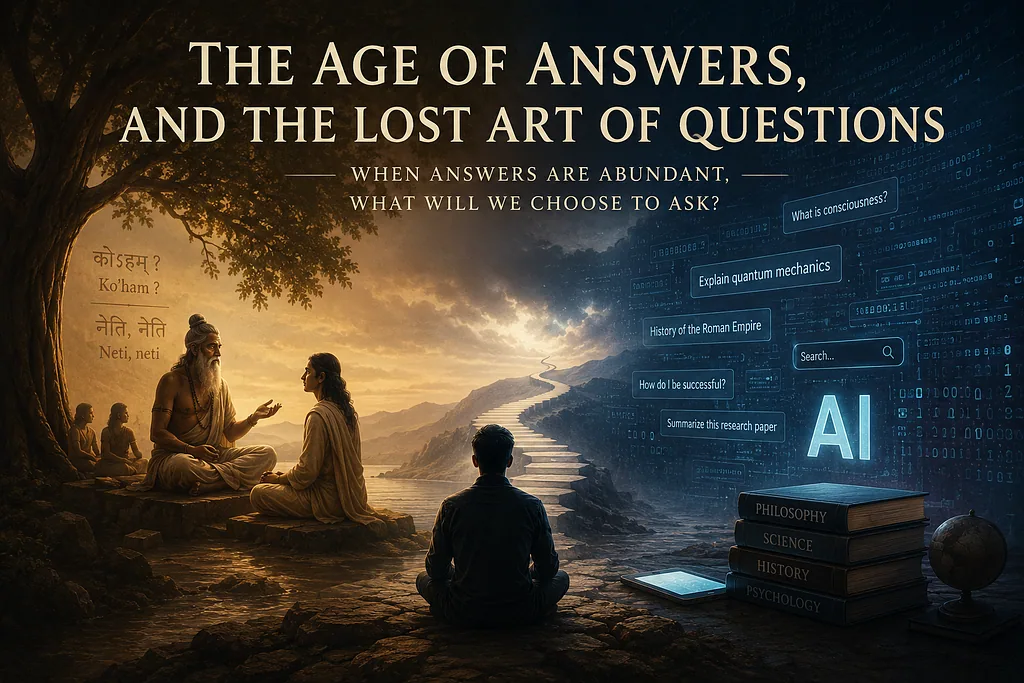
Answers used to be expensive and are now nearly free. If scarcity has only moved rather than disappeared, what became scarce is knowing what to ask.
On this page
- Ancient philosophy often began with a question
- Neti, neti: perhaps one of humanity’s strangest methods of knowing
- AI changes the economics of answers
- But there is a greater danger
- Perhaps this is what we risk losing
- The next intellectual divide may not be between those who know and those who don’t
- Maybe the ancient question returns in a new form
We may be entering the first period in human history where answers are abundant.
For most of history, answers were expensive. You had to travel to a teacher, find a manuscript, spend years studying a discipline, conduct an experiment, or live long enough to acquire experience.
Then came books. Libraries. Search engines.
And now, AI.
Today, you can ask a machine to explain quantum mechanics, interpret a philosophical argument, write software, compare civilizations, analyse a medical paper, or summarize centuries of human thought … in seconds.
The obvious conclusion is that humanity is becoming more knowledgeable.
But there is another possibility:
Perhaps the scarcity has simply moved.
Yesterday, answers were scarce.
Today, good questions are scarce.
Ancient philosophy often began with a question
Some of the most profound moments in Indian philosophical thought do not begin with declarations. They begin with discomfort.
Who am I?
Ko’ham?
What is that which remains when everything I can identify as “me” is examined?
The body changes.
Thoughts change.
Memories fade.
Roles come and go.
So what exactly is the self?
The question is deceptively simple. Yet entire philosophical traditions emerge from refusing to accept the first convenient answer.
The Upanishads repeatedly use dialogue as a vehicle for discovery. Nachiketa questions Yama about death. Gargi questions Yajnavalkya about the foundations of existence. Svetaketu is questioned by his father until his confidence in what he “knows” begins to dissolve.
The method is interesting.
The teacher does not always rush to provide information.
Sometimes, the teacher destabilizes the questioner.
Because the purpose of the question is not merely to obtain an answer.
It is to transform the person asking it.
Neti, neti: perhaps one of humanity’s strangest methods of knowing
“Not this. Not this” …
There is something almost incompatible with our current information culture in neti, neti.
Modern systems are designed to produce an answer.
AI generates coherent answers.
Search engines rank answers.
Social media rewards confident answers.
But neti, neti does something different. It refuses premature closure.
Is this the ultimate reality?
Not this.
Then this?
Not this either.
It is a method that treats certainty with suspicion.
And perhaps that is the deeper distinction between information and inquiry.
Information accumulates.
Inquiry removes assumptions.
One fills the mind.
The other clears it.
AI changes the economics of answers
The internet made information abundant.
AI does something more profound: it makes synthesis abundant.
Previously, even when information was available, someone had to read it, connect it, interpret it, and express it.
Now machines increasingly perform that intermediate intellectual work.
This is extraordinary.
But it creates a curious inversion.
The quality of what you receive increasingly depends on the quality of what you ask.
Two people can have access to the same intelligence and walk away with completely different outcomes … not because one has access to more information, but because one can frame the problem more deeply.
Perhaps intelligence in the AI age will increasingly shift from:
“Do you know the answer?”
to:
“Do you know what is worth asking?”
But there is a greater danger
The danger is not that AI will give us wrong answers.
We already had wrong answers.
The more subtle danger is that easy answers may prevent difficult questions from fully forming.
A question often needs time.
You encounter something you do not understand.
You carry it.
You struggle with it.
Your first explanation fails.
Then your second.
Eventually, the question itself changes.
What began as:
“How do I become successful?”
may become:
“Why do I need success to feel significant?”
And eventually:
“Who exactly is the person whose significance I am trying to establish?”
Those are not three different answers.
They are three different depths of questioning.
An answer engine can respond instantly to the first question.
But human growth may depend on staying with the question long enough to discover that you were asking the wrong question.
Perhaps this is what we risk losing
When every moment of uncertainty can immediately be resolved, uncertainty itself begins to feel like a failure.
We reach for a phone.
We search.
We ask AI.
We receive an explanation.
The loop closes.
But many of humanity’s greatest discoveries began because someone refused to close the loop.
Why do objects fall?
What is light?
What is consciousness?
What happens after death?
What is justice?
What is the self?
The important thing was not merely that these questions eventually produced answers.
It was that someone was willing to remain inside the question.
The next intellectual divide may not be between those who know and those who don’t
If everyone has access to increasingly capable intelligence, knowledge itself becomes less differentiating.
The divide may instead be between people who use intelligence to confirm what they already think and those who use it to discover what they have failed to question.
One person asks:
“Give me the answer”
Another asks:
“What assumptions am I making?”
Another:
“What would have to be true for the opposite to be correct?”
And perhaps the rarest question:
“Am I even asking the right question?”
AI can participate in all four.
But only the human being can decide how far the inquiry should go.
Maybe the ancient question returns in a new form
The irony is beautiful.
We may build machines capable of answering almost every question we can articulate, only to rediscover the insight of traditions thousands of years old:
The most important questions are not necessarily those that produce the fastest answers.
Some questions are meant to be lived.
Who am I?
What is worth wanting?
What is enough?
What do I owe another human being?
What should I do with the brief interval between birth and death?
No machine makes these questions obsolete.
If anything, the age of artificial intelligence may make them more urgent.
Because when answers become abundant, the responsibility shifts back to us.
What will we choose to ask?