Human Quest
The Universal Echoes of Human Thought: Tracing Humanity’s Shared Ideas
Throughout history, cultures separated by vast distances and time have often arrived at strikingly similar symbols, structures, and ideas.
On this page
Throughout history, cultures separated by vast distances and time have often arrived at strikingly similar symbols, structures, and ideas. The pyramids of Egypt bear an uncanny resemblance in purpose and form to the ziggurats of Mesopotamia. Across oceans, Native Americans and Norsemen alike revered the World Tree, a colossal entity believed to connect the heavens, the Earth, and the underworld. Meanwhile, both the Vedic civilization and Taoist tradition describe the universe’s origins with imagery reminiscent of a cosmic egg or golden womb (Hiranyagarbha).
Why do these echoes of thought resonate in the diverse tapestry of human civilization?
Is it mere coincidence, a shared human cognitive imprint, or perhaps evidence of ancient civilizations communicating more than we understand?
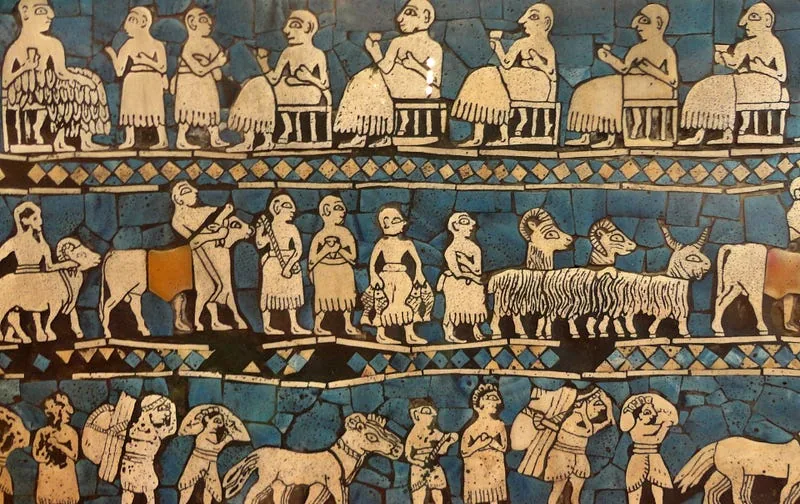
This observation is a topic of significant interest to anthropologists, historians, psychologists, and philosophers. The phenomenon of different cultures converging on similar concepts, symbols, and structures, even without direct contact, is known as “convergent cultural evolution” or “parallel evolution.”
There are several theories and explanations for why this occurs:
- Shared Human Cognitive Architecture:
- Some cognitive scientists and evolutionary psychologists posit that the human brain has evolved certain universal cognitive structures or patterns of thought. These patterns might predispose us to think in particular ways or to develop certain kinds of symbols, beliefs, and practices.
- Carl Jung, for instance, theorized the existence of a “collective unconscious,” a set of shared symbols, archetypes, and motifs that arise in various cultures independently.
2. Response to Similar Environmental Stimuli:
- Humans around the world face similar environmental challenges, such as understanding natural phenomena, coping with death, seeking food, or navigating social relationships. In response, different cultures might independently develop similar solutions or symbols.
- Pyramids and temples, which point skyward, might be seen as attempts to connect with or reach the heavens: a common religious and philosophical aspiration.
3. Functional Solutions to Shared Problems:
- Certain designs or structures might simply be the most practical or efficient solution to a shared problem. For instance, the pyramid structure, while symbolically significant, is also a stable architectural form that allows for large constructions without advanced engineering.
4. Diffusion and Contact:
- While many similar cultural developments occurred independently, we shouldn’t underestimate the degree to which ancient cultures interacted, traded, and influenced each other. Even seemingly isolated cultures might have had indirect contact through intermediaries, leading to the sharing of ideas and practices.
5. Inherent Human Aesthetics or Psychology:
- Some argue that there are universally aesthetic forms or practices that resonate with the human psyche. The act of building grand structures might be a universal expression of human ambition, reverence, or the desire for permanence.
Humanity’s Universal Programming
As we delve into these theories, an even grander question arises: Are humans ‘programmed’ to think a certain way? And if so, who, or what, is the programmer?
“Nasadiya Sukta” from the Rigveda beautifully encapsulates this existential query:
“Who really knows? Who will here proclaim it? Whence was it produced? Whence is this creation? The gods came afterwards, with the creation of this universe. Who then knows whence it has arisen?”
Our world today is rife with divisions, ideological, political, and territorial. Yet, these shared symbols and narratives, embedded in our collective psyche, suggest an underlying unity: a subconscious thread of oneness binding humanity. As societies progress and barriers crumble, it’s a poignant reminder and a fervent hope: may we recognize this innate connection and evolve into a more harmonious and enlightened global civilization.
In the echoes of the past, we find whispers of our shared future.
That’s my musing for today.