Indian Thought
Tracing the origins of Srāddha
The gods are offered svāhā; the ancestors, svadhā. Following one difference in wording back through the Brāhmaṇas to the root of a rite for the dead.
On this page
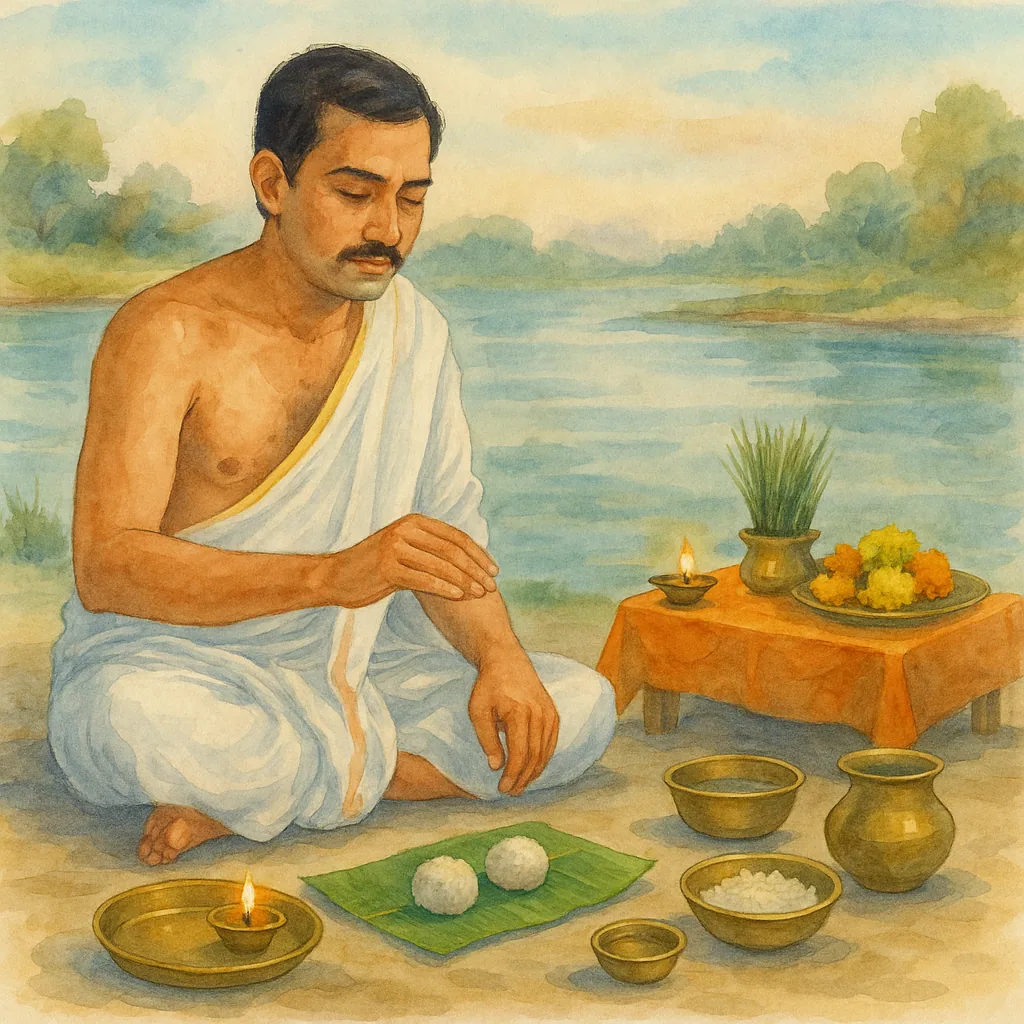
I’m not an overly religious person. I constantly question my beliefs and like to validate what I’ve been told. Yesterday, I performed srāddha for my ancestors as part of Pitru Paksha. As always, I was fascinated .. not so much by the ritual motions themselves, but by the very idea of srāddha. Where did it really come from?
The essence of any srāddha is simple: to remember our ancestors, to offer them food and water, and to use a medium, such as fire, water, or even nature itself, to transfer that essence to them. It sounds symbolic, but its roots go deep into the earliest Indian thought.
Svadhā and Svāhā: Two invocations of offering
What I learnt is that offerings to the gods and offerings to the ancestors were made in different words.
- For the gods, the invocation is svāhā .
- For the ancestors, the invocation is svadhā . The Taittiriya Brāhmaṇa (3.7.9) makes this distinction explicit:
“With svāhā he offers to the gods; with svadhā he offers to the Fathers.”
This is more than a ritual technicality. It shows how the Vedic world placed ancestors on a parallel track with gods: both receive offerings, both sustain cosmic order, but each in their own domain. Deva-yajna nourishes the celestial order, Pitru-yajna nourishes the lineage.
So whenever we say svadhā during srāddha, we are speaking an ancient ritual language that predates the Puranas by more than a thousand years.
Ancestors in the Rigveda
The Rigveda, the oldest text we have, carries hymns to the ancestors (Pitrus). What’s fascinating is how they are described:
In Rigveda 10.14 (a funeral hymn):
-
Yama as the first to die : The hymn establishes Yama as a pioneer who “traveled to the mighty steeps” and “found the way” for all humanity. He is not a fearsome punisher, but a benevolent figure who presides over the realm of the ancestors.
-
The path of the deceased : The hymn describes the soul’s journey after death, guided by Yama’s two four-eyed, spotted dogs. These dogs are said to guard the path and help the deceased reach the realm of the ancestors.
-
Reunion with the ancestors : The ultimate goal for the deceased, according to the hymn, is to be reunited with their “Fathers” ( pitrs ) in a realm of light and happiness. This emphasizes the importance of lineage and the continuity between the living and the dead.
-
The role of ritual and offerings : The hymn calls for offerings of soma and clarified butter ( ghrta ) to Yama and the ancestors. These rituals are believed to ensure a smooth transition for the soul and provide sustenance for the deceased in the afterlife. The offerings reinforce the reciprocal relationship between the living and the dead.
-
The concept of a new body : The hymn suggests that the deceased is granted a new, perfect body in the afterlife, free from the imperfections of their earthly life. This idea of a transformed, resurrected form is a key element of the Vedic eschatology presented in this text. In Rigveda 10.15 (a hymn to the Fathers):
-
Directly calls them to the ritual ground: “Come, O Fathers, in your Vasu forms, in your Rudra forms, in your Aditya forms.”
-
They are seated on the ritual grass, invoked to accept food and drink.
-
The living ask for blessings: prosperity, offspring, protection. In Rigveda 10.16: The fire god (Agni) is asked to carry the deceased to the Fathers, leaving the body to the elements but letting the soul rise.
Together, these hymns establish three things:
- Ancestors are sustained by ritual offerings.
- They are classified like gods, in Vasu, Rudra, Aditya forms.
- The ritual act ensures continuity of lineage , binding the living and the dead.
The three generations: Vasu, Rudra, Aditya
Why are ancestors invoked as Vasus, Rudras, and Adityas? The symbolism is striking.
-
Vasus are elemental deities … water, earth, fire, wind, dawn, moon. They are around us, imminent.
-
Rudras are storm and medicine gods, dwelling in the mid-space, a level above.
-
Adityas are solar gods, shining beyond the storms, timeless. The three generations of ancestors map onto this cosmic hierarchy:
-
The immediate generation (parents) → Vasus (close, elemental).
-
The grandparents → Rudras (intermediaries, a layer above).
-
The great-grandparents → Adityas (remote, shining, cosmic). This isn’t just poetic. It reflects a worldview where memory itself has layers, near, intermediate, remote … each integrated into the cosmic order.
Pinda daana: Feeding across worlds
One of the most important acts of srāddha is pinda daana, offering rice balls (pindas), usually with sesame and water.
-
The pinda symbolizes the body, nourishment, form, and continuity.
-
Offering it is both sustenance and re-embodiment: the Pitrs “partake” of it in subtle essence. The mediums vary:
-
Fire ( Agni ) carries it upwards.
-
Water carries it downstream to the Pitrs.
-
Even if birds or animals consume it, the essence is believed to be transferred. The Satapatha Brahmana is clear: what matters is not the gross food, but the rasa (essence) that reaches the ancestors through the medium.
Later codification in the Garuda Purana
Much of the detailed ritual of srāddha and the graphic descriptions of the afterlife come from the Garuda Purāna. This Purāna turns srāddha into a structured manual and ties it to eschatology .. the journey of the soul, the various hells, and so on.
But this is clearly not the origin. The beginnings are in the Rigveda, in the hymns that call ancestors as Vasu, Rudra, Aditya, and in the Brahmanas that split svāhā from svadhā. The Garuḍa Purāṇa only gave late sophistication to something already ancient.
So what is the intent of all this?
So what is the intent of all this? Strip away the ritual complexity, and the essence is clear: to remember, to honor, to connect. We call our ancestors in the forms of Vasus, Rudras, and Adityas because memory itself has layers: near, intermediate, remote. We offer food not because they literally eat it, but because it symbolizes continuity, care, and gratitude across generations.
As I placed the pindas into yajna kundam yesterday, I felt I wasn’t just repeating a custom: I was touching a tradition that began in the Rigveda, was refined through the Brāhmanas and Grhya Sutras, and lives on in every family that pauses to remember.
Srāddha, then, is less about ritual mechanics and more about carrying forward remembrance as dharma. In that remembrance, the past lives on, the present is anchored, and the future is blessed.
That’s my learning for today!