Technology & Society
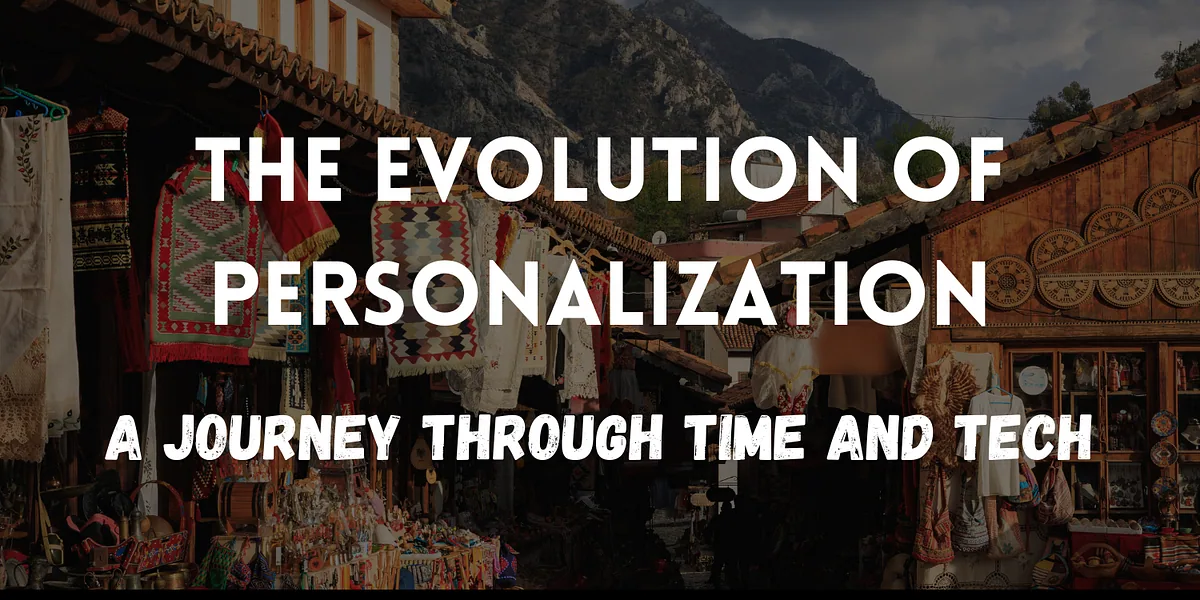
The Evolution of Personalization: A Journey Through Time and Tech
In the labyrinth of human desires, the yearning for a personalized experience stands as a universal constant, transcending time, geography, and culture.
On this page
- The Ancient Bazaars: The Original Social Networks
- Middle Ages: The Era of Guilds and Bespoke Craftsmanship
- Renaissance and Early Capitalism: The Dawn of Consumer Choice
- The Industrial Age: The Paradox of Standardization and Personalization
- The Information Age: Algorithmic Personalization
- Future of Personalization: Ethical Personalization?
In the labyrinth of human desires, the yearning for a personalized experience stands as a universal constant, transcending time, geography, and culture. As we navigate through life, whether it’s walking through ancient bazaars scented with exotic spices or scrolling through an online store powered by complex algorithms, we are invariably attracted to experiences that resonate with our individuality.
But how has the essence of personalization evolved across different epochs? What are the technological, cultural, and ethical considerations that have shaped, and continue to shape, this intriguing aspect of human interaction? From the intimate dealings of ancient marketplaces to the algorithm-driven retail ecosystems of today, this post embarks on a historical journey to dissect the changing faces of personalization.
The Ancient Bazaars: The Original Social Networks
In the bustling marketplaces of ancient Mesopotamia, India, Egypt, and Rome, bazaars were far more than mere hubs of economic activity; they were the original social networks where relationships were key. Here, traders, often considered the first data scientists, knew their customers by name, and every transaction was imbued with social cues and non-verbal communication.
This ancient seller wasn’t merely a salesperson but a multi-faceted individual, a marketer, psychologist, and ethnographer rolled into one. They keenly observed who paused to admire their wares, who touched the fabric, sniffed the spices, or engaged in conversation. These practices were data collection at its most primal and organic, and the ethical dimension lay in the mutual respect and transparent intentions that governed these interactions.
Personalization wasn’t just a marketing strategy; it was an intrinsic part of human interaction. In this era, customers had a ‘profile,’ albeit one stored in the trader’s memory rather than a database. Regular customers might even find that the best goods had been set aside for them. Personalization, at this point, was like a bespoke suit: crafted through acute observations and direct conversations, and tailored to fit the intricacies of individual relationships, governed by unwritten yet highly respected social norms and rituals.
The concept of personalization originated here, born from complex shades of social, psychological, and economic threads, and it was as far from a one-size-fits-all approach as could be imagined.
Middle Ages: The Era of Guilds and Bespoke Craftsmanship
The Middle Ages saw the rise of guilds, which became a bedrock of expertise, specialization, and quality control. To become a master craftsman, one had to undergo years of meticulous apprenticeship and pass rigorous examinations. Guilds were not just institutions; they were social contracts that promised quality and expertise.
In such an environment, personalization found its expression through the craftsman’s skill. Tailors, blacksmiths, and potters didn’t just offer products; they offered experiences. A tailor, for instance, didn’t just sew garments but crafted an ensemble attuned to an individual’s physique, posture, and even social standing. The very act of purchase was a collaborative venture, as artisans often consulted with clients to determine the most suitable materials, designs, and functionalities.
Long-term relationships were the norm, transcending mere commercial transactions. A family could patronize the same tailor for generations, creating a lineage of personalized experiences. This multi-generational relationship allowed artisans to anticipate not just individual but also familial needs, thereby deepening the level of personalization to a hereditary context.
This period could be seen as the golden age of artisanal personalization, an epoch where each product was not just a commodity but a chapter in an ongoing narrative between the craftsman and the customer. Every crafted item was a testament to the individual’s unique needs and the craftsman’s unparalleled skill, making mass production an alien concept.
Renaissance and Early Capitalism: The Dawn of Consumer Choice
As Europe emerged from the Dark Ages into the luminosity of the Renaissance, there was an unprecedented focus on the individual as a unique entity. The zeitgeist of the time, punctuated by art, philosophy, and a burgeoning sense of personal liberty, also influenced consumption habits. The individual was no longer just a cog in the wheel of familial, communal, or religious structures; he or she was a connoisseur, a distinct entity with unique tastes and aspirations.
At this time, the concept of choice took center stage. With the expansion of trade routes and the advent of early capitalism, a plethora of options unfurled before the consumer. From the silks of Asia to the spices of the Indies, global trade ensured a wide variety of goods were at one’s fingertips. A person’s selections were not just functional choices but expressions of their individuality, their understanding of the world, and, importantly, their social standing.
The Renaissance also ushered in the notion of specialized shops, a precursor to modern retailing. These weren’t just market stalls but dedicated spaces that sold particular types of goods, whether it be fabrics, spices, or books. Personalization took on an advanced form; it was not just about the product but also about the experience of choosing it. Shopkeepers began to adapt their offerings, subtly recognizing that customers were not just buyers but individuals with varying tastes and needs.
Therefore, the Renaissance period added a new dimension to personalization, going beyond the product to focus on the experience of choice. The individual was not merely a consumer but a participant in the shaping of his or her reality through choices. In many ways, this period laid the groundwork for modern consumerism, wherein one’s identity could be etched by preferences, setting the stage for an increasingly segmented and personalized marketplace.
The Industrial Age: The Paradox of Standardization and Personalization
As the gears of the Industrial Revolution turned, the landscape of personalization underwent a seismic shift. Factories, a hallmark of this era, enabled mass production of goods on an unprecedented scale. This seemingly contradictory development posed a conundrum: How could individual preferences be met in an age of standardization? The answer lies in the nuanced ways society adapted to these new realities.
Department stores, for instance, epitomized this tension between mass production and individual choice. These establishments, like Macy’s in the United States or Harrods in the United Kingdom, offered a vast array of goods under one roof. The sheer variety in choices allowed for a semblance of personalization even if the items themselves came off assembly lines. You could still find a dress, a teapot, or a piece of furniture that spoke to your unique needs or tastes, albeit from a pre-made selection.
Furthermore, the rise of mail-order catalogs brought personalization into the homes of those who could not readily access these department stores, especially in rural America. Companies like Sears offered catalogs that one could peruse in the comfort of their own home, handpicking items that appealed to their specific preferences and requirements.
And then came marketing, a discipline that recognized the tension between mass production and individual choice and sought to bridge the gap. Brands began crafting narratives and ad campaigns designed to make each consumer feel special. Coca-Cola, for instance, employed slogans like “The Real Thing” to create an emotional connection with consumers. Even though the product was mass-produced, the experience of consuming it felt personal, intimate, and unique.
In summary, the Industrial Age was not devoid of personalization; rather, it reframed it. The products might have become standardized, but the experience of selection and the narrative around those products retained the essence of individual preference and choice. Standardization and personalization coexisted, each subtly influencing the other in shaping consumer behavior.
The Information Age: Algorithmic Personalization
In the current Information Age, technology’s exponential growth has radically transformed our understanding of personalization. Now, algorithms have become the new intermediaries between sellers and consumers, taking on the ancient role of the market vendor who once knew each customer by name. The dynamics have shifted, but the objective remains the same: delivering a tailored experience to each individual.
E-commerce and SaaS platforms are at the forefront of this revolution. Recommendations are not just suggestions anymore; they are the outcome of complex algorithms that analyze a plethora of variables, from browsing history to time spent on a page. As a seller, this technological arsenal offers an unparalleled depth of understanding about your customer base, enabling highly targeted marketing strategies. Think of dynamic pricing, personalized discounts, or even emails that address the consumer by their first name and recall their past interactions with the service. Personalization has never been so detailed, nor so scalable.
However, this granular level of personalization does not come without its challenges and ethical dilemmas. Issues surrounding data privacy have come to the forefront, making consumers wary of how their information is being used. Moreover, the algorithms themselves can sometimes perpetuate societal biases, posing ethical questions that businesses have to navigate carefully.
In essence, the Information Age brings the promise and the peril of personalization to new heights. While technology enables an almost telepathic understanding of consumer needs and preferences, it also forces society to confront new ethical and philosophical challenges. These include the commodification of personal data and the ethical considerations that arise when machine learning models influence consumer choice and even social norms.
Future of Personalization: Ethical Personalization?
As we look toward the future, the next frontier in personalization seems increasingly entangled with ethical considerations. While advancements in artificial intelligence, machine learning, and data science promise ever-more customized experiences, the public’s growing awareness of data privacy issues cannot be ignored.
From the seller’s standpoint, the emerging trend points towards ‘ethical personalization.’ This involves a transparent approach to data collection and usage, a feature that is likely to become a unique selling proposition in the increasingly data-conscious marketplace. Future businesses may adopt “privacy by design” as a foundational principle, integrating data protection into the very architecture of their products and services. Legislation like the European Union’s GDPR serves as a framework for what ethical data handling should resemble, adding both legal necessity and customer appeal to the equation.
From the consumer’s perspective, the future likely holds more control and agency over how their data is used. Transparent opt-in, and opt-out options, simplified explanations of algorithmic functioning, and even user-friendly ways to adjust personalization settings could become standard features.
In conclusion, the road ahead for personalization is both exciting and fraught with complexity. While technological innovations will continue to offer unparalleled customization, ethical imperatives will increasingly dictate the boundaries of these personalized experiences. In a way, this represents a return to the foundational human need for both individuality and communal respect, ensuring that the age-old quest for personalization evolves without compromising individual autonomy or societal norms.
That’s my learning for today.