Ancient → Modern
When Aryabhata Meets Aditya L1
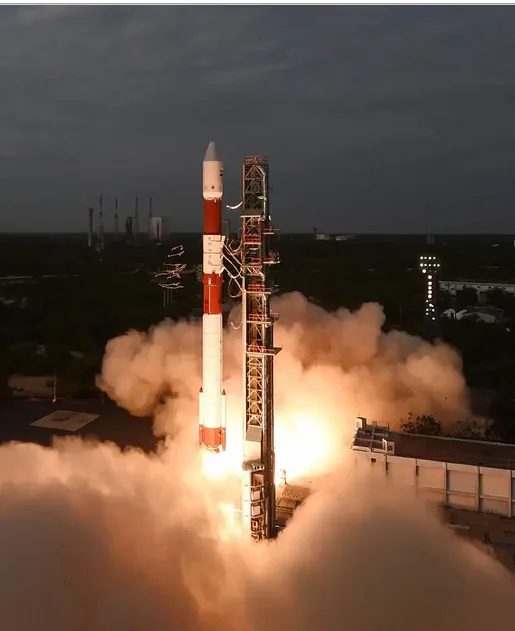
As ISRO’s Aditya L1 spacecraft soared into the sky from the Satish Dhawan Space Centre, a new chapter was added to India’s ambitious space exploration narrative.
On this page
As ISRO’s Aditya L1 spacecraft soared into the sky from the Satish Dhawan Space Centre, a new chapter was added to India’s ambitious space exploration narrative. Launched on a trusted PSLV, the spacecraft embarks on a 125-day voyage to get an intimate view of our Sun. Stationed 1.5 million kilometers from Earth, at the Sun-Earth Lagrangian point, Aditya L1 aims to unlock the secrets of the Solar corona and shed light on the intricacies of the Solar wind. This monumental event stands not just as a testament to modern Indian scientific capabilities, but also as a reiteration of a legacy that traces back to the dawn of civilization itself.
This launch echoes not just in the corridors of ISRO but reverberates through the annals of Indian history, reaching back to ancient astronomers like Aryabhata, Brahmagupta, and Bhaskara II. These trailblazers in the field of astronomy laid the conceptual foundations that were far ahead of their time, and their insights percolated through the ages, influencing thought and scientific understanding in diverse cultures around the world.
Today, as the Aditya L1 spacecraft journeys through space, India reclaims its position in the field of astronomy and space exploration, revitalizing a quest that began thousands of years ago. It’s as if the ancient sages and astronomers are whispering through time, reminding us that the search for cosmic truths is deeply embedded in the Indian psyche.
In this blog, I will explore the rich heritage of ancient Indian astronomy, drawing parallels with today’s cutting-edge initiatives like the Aditya L1 mission. I aim to demonstrate that India’s current strides in space exploration are not isolated events, but part of a long-standing tradition that reflects an innate desire to understand the cosmos, a quest that is as timeless as it is boundless.
Vedic Foundations
The Vedas, penned down over 3,000 years ago, remain among the world’s oldest existing texts. But did you know that they also contain remarkably sophisticated astronomical observations? Vedic priests were not just religious figures; they were also astronomers and mathematicians. Rituals needed to be conducted at precise times, dependent on the configurations of celestial bodies. This necessitated a deep understanding of the cosmic dance of stars and planets.
The harmonious marriage between spirituality and science in Vedic times is noteworthy. It tells us that, in ancient Indian thought, the spiritual quest was not separate from the intellectual endeavor to understand the universe. Both were seen as paths leading to the same ultimate truth.
Among the earliest Indian astronomers, figures like Sage Yajnavalkya stand out. His work in the “Shatapatha Brahmana”, a Vedic text dating around 1800 BC, demonstrates precise calculations about the distance between the Earth and the Moon.
Yajnavalkya proposed a numerical value for the distance between the Earth and the Moon. According to his calculations, this distance was around 108 times the diameter of the Moon. This approximation may sound oddly specific, but it is grounded in keen observation and mathematical reasoning.
Yajnavalkya’s calculation is an early example of what today we might call “astronomical unit analysis.” Although he did not have telescopic technology to measure the distance directly, he relied on ratios and angular sizes, which were observable by the naked eye.
While the value Yajnavalkya proposed is an approximation, and modern measurements provide a more accurate value, it is crucial to remember the time and resources available to him. In that context, Yajnavalkya’s estimate was a remarkable feat. Even today, the ratio he proposed (108:1) is close to the modern values (110:1), considering the vast advancements in technology and methodology we’ve seen.
Such accomplishments tell us that Indian astronomy was not a mere speculative venture. It was rigorous, analytical, and relied on empirical data. Scholars of the time understood that to gain accurate insights into the complexities of the universe, one had to marry intuitive understanding with logical rigor.
Nalanda University: The Confluence of Disciplines
Nalanda University, situated in the Indian state of Bihar, stands as one of history’s most illustrious centers of education. Founded in the 5th century CE, it attracted scholars from all corners of the known world, China, Central Asia, Tibet, and beyond. While the university was a hub for a variety of subjects (philosophy, theology, grammar, and medicine among them), it had a particular emphasis on astronomical studies.
Before delving into the subject matter, let’s talk briefly about the structure of Nalanda University. The educational institution was built as a complex of temples and monasteries. It had an extensive library, known as the “Dharmaganja” (Treasury of Truth), divided into three large buildings, said to house hundreds of thousands of manuscripts. Scholars had to pass rigorous oral examinations to be admitted, emphasizing the university’s commitment to high intellectual standards.
Astronomy was one of the pivotal subjects taught at Nalanda. The science was not just about studying the stars and planets; it was interwoven with other disciplines like philosophy, physics, mathematics, and even spirituality. Scholars used detailed mathematical models to predict celestial events like eclipses, planetary motions, and the phases of the moon. Their work was not just theoretical; observational astronomy was also encouraged. Instruments made of wood and metal were used for capturing celestial angles and the apparent sizes of heavenly bodies.
The teachings of astronomical giants like Aryabhata and Varahamihira were key elements of the curriculum at Nalanda in the later days. Aryabhata’s “Aryabhatiya,” a seminal text on mathematics and astronomy, served as a significant resource for scholars. The work of Yajnavalkya, whom we discussed earlier, would also have found resonance in this scholastic environment.
Aryabhata: The Astronomical Prodigy
In the timeline of Indian astronomy, one name looms large: Aryabhata. Born in 476 AD, this prodigious astronomer and mathematician authored the Aryabhatiya, a groundbreaking work that drastically altered the course of Indian astronomy. At the youthful age of just 23, Aryabhata presented theories that would be considered revolutionary even by modern standards.
He asserted that the Earth rotates on its axis, explaining the daily motions of stars and planets, a claim that would not be accepted in the Western world until many centuries later.
Before delving into Aryabhata’s revolutionary concept, it’s essential to understand the prevalent beliefs during his time. Most ancient civilizations, including Greek scholars like Ptolemy, advocated the geocentric model, wherein the Earth was considered stationary at the center of the universe. According to this view, the celestial bodies (including the Sun, Moon, and stars) moved in orbits around the Earth.
Against this backdrop, Aryabhata’s assertion that the Earth rotates on its axis was indeed revolutionary. He postulated that the apparent westward motion of celestial bodies is due to the eastward rotation of the Earth on its axis. This concept explained the daily phenomena of sunrise and sunset as well as the movement of stars across the sky.
Aryabhata didn’t just make a claim; he provided mathematical calculations and observational evidence to back it up. He observed that the stars returned to the same position in the sky approximately every 24 hours, which could be explained if the Earth rotated on its axis. His mathematical models calculated the period of this rotation with a good degree of accuracy.
The “Aryabhatiya” outlines the theory, providing calculations related to the Earth’s rotation, and also describes the resulting effect on the movement of celestial bodies. While Aryabhata’s work was primarily observational, his hypotheses were rooted in careful scrutiny and rigorous mathematical calculations.
Initially, Aryabhata’s ideas met with resistance and even ridicule because they contradicted popular beliefs. But with time, these theories found acceptance among other Indian scholars and also influenced Islamic astronomers who translated the “Aryabhatiya” into Arabic.
The shift from a geocentric to a heliocentric (or sun-centered) model of the solar system would take many more centuries and required the works of Copernicus, Galileo, and Newton. Yet, Aryabhata’s assertions about Earth’s rotation were a significant leap forward, influencing subsequent generations of astronomers both within India and beyond.
Brahmagupta: The Scholar of Zero and Astronomy
Brahmagupta, born in 598 CE, stands out as a pivotal figure who bridged astronomy and mathematics. His seminal work, “BrahmaSphutaSiddhanta,” became an influential text in medieval Indian astronomy. Among its many insights, this work outlined methods for calculating the position of heavenly bodies over time, an essential component for calendar reform.
One of Brahmagupta’s most significant contributions was in the area of trigonometry, useful for astronomical calculations. He defined trigonometric functions, provided various formulae, and expounded on how to use these to estimate celestial positions.He also touched upon the concept of gravitation long before Isaac Newton, discussing why objects fall towards the Earth. Most notably, his work on the properties of zero, such as the rule that any number divided by zero is infinity, revolutionized both mathematics and the computations required for more accurate astronomy.
Bhaskara II: The Polymathic Genius
Often called Bhaskaracharya, Bhaskara II was born in 1114 CE and is most famous for his comprehensive work “Siddhanta Shiromani.” This masterpiece is divided into four sections, two of which (“Grahanadhikar” and “Goladhikar”) deal explicitly with mathematical astronomy. Bhaskara II is renowned for his concept of instantaneous motion, which might be considered a precursor to the idea of differential calculus.
He refined Aryabhata’s model for planetary motion, correcting discrepancies that arose over time. His methods were so precise that they could be used to predict celestial events several years in advance accurately. Additionally, he calculated the time taken by the Earth to orbit the Sun to nine decimal places, showing the advancement of observational and computational methods in his time.
Nilakantha Somayaji: The Reviser of Astronomical Models
A significant figure from the Kerala School of Astronomy and Mathematics, Nilakantha Somayaji was born in 1444 CE. His most crucial work, “Tantrasangraha,” offered a revised version of ancient Indian astronomical models. He made adjustments to Aryabhata’s theories and introduced a more accurate model that allowed for the heliocentric motion of the inner planets (Mercury and Venus) around the Sun while maintaining a geocentric model for the outer planets.
His work provided a halfway point between the entirely geocentric Ptolemaic system and the fully heliocentric Copernican model, offering a transitional framework that acknowledged the intricacies of planetary motion. Nilakantha’s influence would ripple through the Kerala School, inspiring further research in trigonometry and calculus, which in turn fed back into more accurate astronomical models.
Certainly, it’s worth acknowledging that the four astronomers mentioned here are but the tip of the iceberg when it comes to India’s illustrious history in the field of astronomy. Luminaries like Varahamihira, who wrote the foundational text “Pancha-Siddhantika,” and Lalla, author of “Sishyadhivriddhida Tantra,” laid groundwork in diverse areas ranging from astrological calculations to eclipse predictions. Then there are scholars like Harsha, and Vateshwara, among others, whose work in trigonometry, calculus, and observational astronomy profoundly influenced not just Indian science but also provided essential knowledge that was absorbed into Islamic and European scientific traditions. Each of these astronomers offers a universe of insights worth exploring, and it’s entirely possible that each could be the subject of an expansive study or article in the future. For now, this piece serves as an introductory glance at the expansive sky of ancient Indian astronomy.
Decline and Rediscovery
During the colonial era, unfortunately, the educational and scientific institutions in India underwent a period of stagnation and decline. The focus shifted from indigenous knowledge systems to those imported from Europe, leading to an erosion of the scientific and philosophical contributions that had been developed over millennia on the subcontinent. Nalanda University, once a beacon of intellectual pursuit, had been destroyed much earlier during the 12th-century invasions. Similarly, other centers of learning faced neglect, causing a significant loss in the transmission of traditional knowledge.
However, despite these setbacks, the last century has seen a concerted effort to rediscover and revitalize India’s scientific heritage. The founding of the Indian National Science Academy, the Council of Scientific and Industrial Research, and more recently, organizations like ISRO, represent India’s reemergence as a scientific power.
ISRO’s Chandrayaan and Aditya L1 missions thus serve as an emblematic event, signaling India’s return to its astronomical roots. The launch of Aditya L1 mission today is not just the accomplishment of modern science but also a salute to the thinkers, astronomers, and mathematicians of ancient India. As the spacecraft prepares to unveil the secrets of the Sun, one cannot help but feel that it is rekindling a cosmic connection that was forged by ancient Indian astronomers.
As we delve deeper into the 21st century, we find that the questions that captivated the minds of ancient astronomers are far from answered. We continue to grapple with the mysteries of the cosmos, albeit armed with more advanced technology and theoretical models. India’s contemporary scientists, backed by the legacy of their ancestral thinkers, are now contributing to the collective human endeavor to decipher the intricacies of the universe.
The current ISRO missions are a point of convergence, where the past meets the present and future. This contemporary endeavor is a potent reminder that the quest for understanding the cosmos is an eternal voyage, one that transcends temporal, geographical, and even civilizational boundaries.
For modern India, the forays into space exploration serve dual purposes. Firstly, they contribute to humanity’s collective knowledge about the universe, fitting neatly into a global scientific landscape that is more collaborative than ever before. Secondly, these endeavors serve as a cultural renaissance, revitalizing a sense of pride and continuity in a nation that has been the cradle of scientific thought for millennia.
Today’s Aditya L1 mission, while representing cutting-edge scientific achievement, is also a manifestation of a cultural and philosophical quest that is deeply rooted in India’s past. The celestial quest of the spacecraft is like a modern-day echo of the Vedic hymn in the Rigveda: “What was the wood, and what was the tree from which they built heaven and Earth?” Only now, the hymn takes the form of algorithms, advanced telemetry, and solar probes, with eyes set firmly on the blazing heart of our Solar System, yet reverberating with the ancient wisdom and curiosity that have always been the hallmark of India’s unique scientific and philosophical landscape.
It is a journey that takes India full circle.