Ancient → Modern
Universe’s Hologram has an Ancient Parallel
In our quest to understand the universe, science often surprises us with ideas that echo ancient wisdom. One such idea is the Holographic Principle, which suggests our vast universe might be like a giant hologram.
On this page
In our quest to understand the universe, science often surprises us with ideas that echo ancient wisdom. One such idea is the Holographic Principle, which suggests our vast universe might be like a giant hologram. This modern theory resonates with an ancient Sanskrit saying from the Yajurveda: “Yatha pinde, tatha brahmande.”
The parallels between a modern scientific theory and ancient aphorism suggest that our quest for understanding is a timeless journey, transcending eras and disciplines. It hints that, despite the vast evolution of thought and technology, there’s an underlying thread of unity in the way we perceive and interpret the universe.
This continuity may be a testament to the enduring nature of human wonder and our unchanging drive to find patterns and meaning in the vast tapestry of existence. Dive with us as we explore this fascinating overlap.
The Holographic Principle
To understand the holographic universe theory, one first needs to grasp the concept of a hologram. A hologram is a three-dimensional image produced when a laser beam illuminates a photographic recording of an object. The fascinating part? Even if the holographic plate is shattered into pieces, each fragment can still project the entire image, albeit with less clarity. This is because every part of the hologram contains the whole.
The holographic principle is one of the most captivating theories in modern physics, which emerged from our attempts to understand the nature of black holes and quantum gravity. The path leading to this principle is a tapestry woven with threads of relativity, quantum mechanics, and deep philosophical inquiries. Let’s delve deeper.
The Black Hole Information Paradox
The backdrop to the holographic principle starts with the study of black holes, those mysterious regions of spacetime where gravity pulls so much that nothing, not even light, can escape.
Stephen Hawking, in the 1970s, discovered something extraordinary about black holes. Using the principles of quantum mechanics, he found that black holes are not truly “black” but emit radiation, which is now known as Hawking radiation. Over time, as a black hole emits this radiation, it loses mass and eventually evaporates.
But here’s the catch: quantum mechanics states that information can never be lost. If a black hole evaporates, what happens to the information about the stuff that fell into it? This dilemma is known as the black hole information paradox.
Birth of the Holographic Principle
In trying to resolve this paradox, physicist Leonard Susskind and others proposed the holographic principle in the 1990s. They suggested that all the information sucked into a black hole is stored on its two-dimensional event horizon, much like information on a 2D hologram that can represent 3D data.
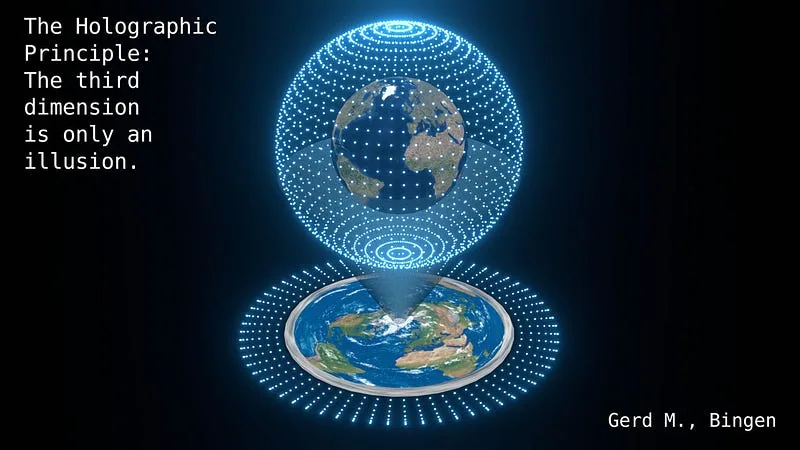
Imagine you’re looking at a very detailed painting of a forest. In this painting, you can see trees, animals, rivers, and more. But what if I told you that all the information to make this detailed painting is stored on the frame around it? That’s a bit like the Holographic Principle. It says that everything we see and experience in our big 3D world might just come from information stored on a 2D boundary, like the frame of our painting.
This idea was radical. It proposed that our entire 3D universe might be a projection of 2D information stored on some distant 2D surface.
Theoretical Support: AdS/CFT Correspondence
The most substantial support for the holographic principle came from a discovery in string theory called the AdS/CFT correspondence. Proposed by Juan Maldacena in 1997, it showed a relationship between a gravitational theory in a higher-dimensional space (Anti-de Sitter space or AdS) and a quantum field theory without gravity on its boundary (Conformal Field Theory or CFT).
Let’s break it down. Say you have a big fishbowl full of water and colorful fish swimming around. This fishbowl is our 3D world. Now, imagine that every movement and action of the fish can be seen as ripples and waves on the surface of the water. Even though the surface is just 2D (flat), it can tell us everything about the 3D world of the fish inside the bowl.
So, the AdS/CFT Correspondence is like saying that we can understand the whole 3D story inside the fishbowl just by looking at the 2D surface.
This discovery was groundbreaking because it provided a concrete realization of the holographic principle. The entire bulk of space could be described by a theory on its boundary.
“Yatha pinde, tatha brahmande”
The phrase “Yatha pinde, tatha brahmande” finds its roots in Yajurveda, one of the ancient texts of India. The underlying philosophy it conveys is a cornerstone of many Indic spiritual traditions.
The complete phrase is often rendered as:
“Yatha pinde, tatha brahmande; yatha brahmande, tatha pinde.”
Which translates to:
“As is the microcosm, so is the macrocosm; as is the macrocosm, so is the microcosm.”
The phrase is a profound statement about the nature of reality and the relationship between the individual (or any particular entity) and the cosmos.
“Pinda” refers to the individual or the microcosm, which can be a human being, an atom, or any singular entity.
“Brahmanda” refers to the universe or the macrocosm, the vast expanse that contains galaxies, stars, planets, and everything we know.
The phrase suggests that the same laws, principles, and patterns that govern the individual also govern the universe. In essence, by understanding oneself or the microcosm, one can gain insights into the universe or the macrocosm, and vice versa.
This philosophy is also evident in the practice of yoga and meditation, where diving deep within oneself can lead to universal realizations.
Connections
The Holographic Principle posits that the entire universe, with all its three-dimensional complexity, can be encoded or represented on a two-dimensional boundary.
In other words, a smaller, simpler representation (the boundary) contains all the information needed to describe the vastness of the universe. This is strikingly reminiscent of “Yatha pinde, tatha brahmande.” Just as the phrase suggests that understanding the individual can provide insights into the universe, the Holographic Principle suggests that a 2D boundary can encode the information of the 3D universe. Both ideas revolve around the concept that the whole can be understood by studying a part, and the nature of the part reflects the nature of the whole.
In essence, the Holographic Principle can be seen as a modern, scientific exploration of the ancient philosophical idea captured by “Yatha pinde, tatha brahmande.” Both remind us of the interconnectedness and unity of all things, suggesting that the mysteries of the vast cosmos might be unraveled by looking inward or by studying the simpler representations that reflect its nature.
That’s my learning for today!