Ancient → Modern
Sanskrit in the Sahara
In the pages of history, scattered like elusive gemstones, are discoveries that reshape our understanding of the past.
On this page
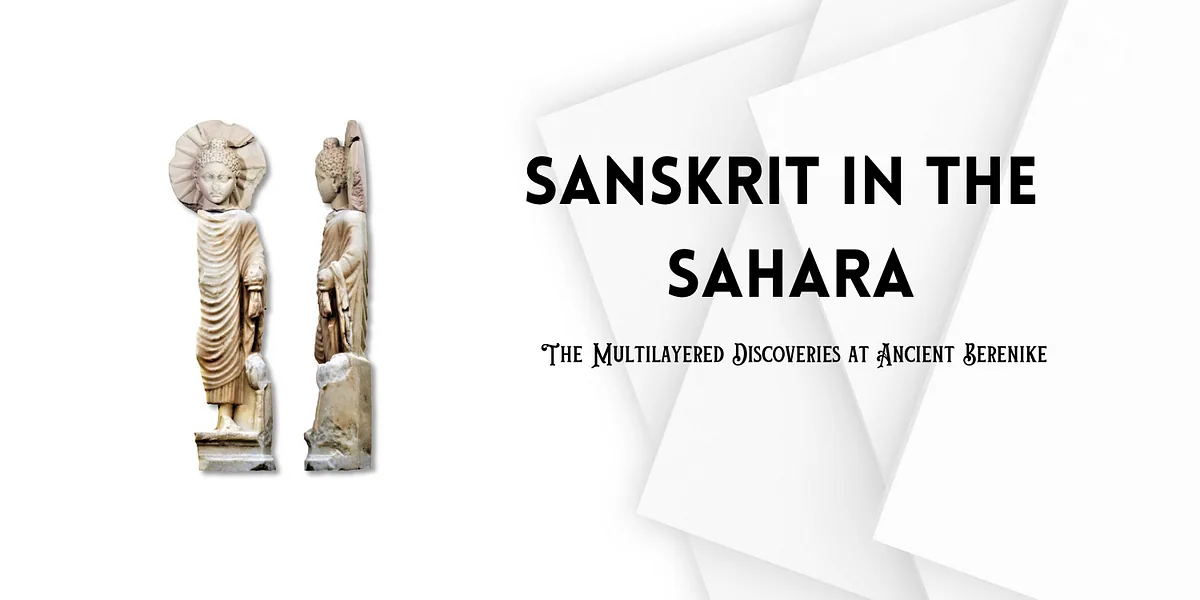
In the pages of history, scattered like elusive gemstones, are discoveries that reshape our understanding of the past. And just when it seems that the annals of time have been pored over meticulously, a groundbreaking revelation springs forth. One such discovery, unearthed at the ancient Egyptian port city of Berenike in 2022, has not only sent ripples across the archaeological world but has also offered us a new lens through which to view the fascinating interplay between civilizations of antiquity. A 1,900-year-old statue of the Buddha and an ancient Sanskrit inscription were found at this historical junction of trade, revealing startling connections between Egypt, Rome, and the Indian subcontinent.
The discovery provokes wonder and introspection on a variety of fronts: the cultural milieu that resulted from these ancient connections, the economic underpinnings that allowed for such intercontinental relations, and the shared human pursuit of both material and spiritual enrichment. This blog post aims to delve into these facets by exploring the ancient trade routes from India to Africa and Europe, understanding the latest find at Berenike, and evaluating its broader significance in the context of history and philosophy.
Now, let us embark on this journey through time, as we unravel the threads of a tapestry woven not just by kings and emperors, but by traders, artisans, and philosophers who crossed both tangible borders and boundaries of the mind.
Ancient Maritime Trade Routes from India to Africa to Europe
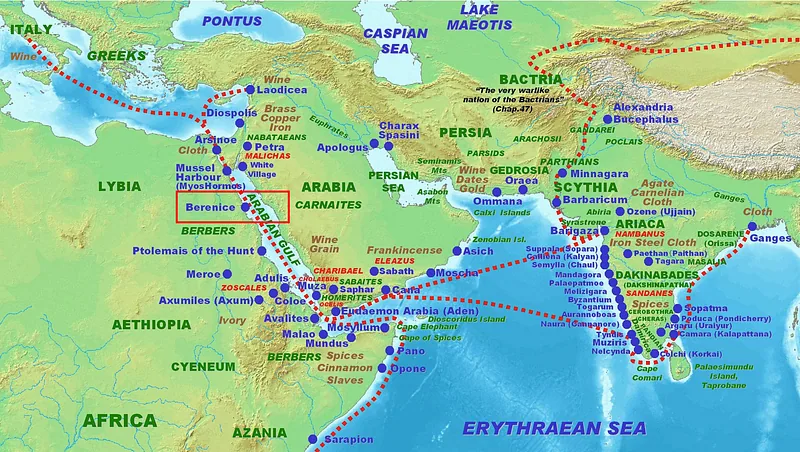
Long before the Roman Empire stretched its wings across Europe and beyond, ancient civilizations had already recognized the value of international trade. The roots of such exchanges date back to the days of the Indus Valley Civilization, where evidence suggests a pattern of trade activities with Western lands. Fast forward to the Roman era, and we find this pattern not only sustained but thriving, evolving from primitive barter systems to sophisticated networks of maritime trade.
As highlighted in one of my earlier blog posts, India was not a passive player in these international trade systems. Pliny the Elder’s writings afford us glimpses into how the Roman world perceived Indian traders as significant partners. These were not isolated interactions but part of a larger, consistent trade network. Western ports in India such as Muziris and Bharuch became bustling centers of commerce, contributing to the trade dynamics described by Pliny and reaffirmed by indigenous sources that mention “Yavana” or Greek/Roman traders.
While ancient texts and documents do provide evidence of these trade relationships, they are often considered insufficient to fully reconstruct the past. The reason? A palpable scarcity of artifacts and material culture that could serve as irrefutable evidence of these maritime connections. The accounts of travelers, the observations of historians, and the scripts of traders can tell us only so much. Therefore, the significance of physical artifacts becomes immeasurably greater.
Against this backdrop, the port city of Berenike in Egypt stands out as a monumental testament to ancient India’s overseas interactions. As ships docked at Berenike, they unloaded a plethora of goods ranging from spices like pepper to valuable ivory, textiles, and semi-precious stones. But these material exchanges were merely the tip of the iceberg. What was also happening in the undercurrents was a cross-cultural dialogue, ideas, philosophies, and religious ideologies were traversing these seas, facilitating a level of cultural exchange that is often overshadowed by the focus on material goods.
The Current Find at the Berenike Site: A Layered History and Two Remarkable Artifacts
Nestled on the coast of the Red Sea, the ancient port city of Berenike served as a vital hub for maritime trade. Its strategic location was not a mere coincidence but a well-calculated choice that placed it at the confluence of multiple sea routes, connecting India, Africa, and the Roman Empire. This prime location allowed Berenike to serve as a transshipment point, where goods could be offloaded from sea vessels and then transported overland across the desert to the Nile, and from there to Alexandria and beyond. Over the years, this port city has been the focal point of multiple excavations that seek to unravel its past and contextualize its significance in the broader historical narrative.
Between 2018 and 2022, renewed archaeological interests have once again turned their attention to Berenike, leading to some astonishing finds that add new layers to our understanding of this city. In the ever-expanding repository of artifacts unearthed from this site, two recent discoveries stand out, both for their singular nature and the stories they seem poised to tell: these are a Buddha statue and a Brahmi Sanskrit inscription.
The Buddha Statue: An Intricate Narrative in Stone
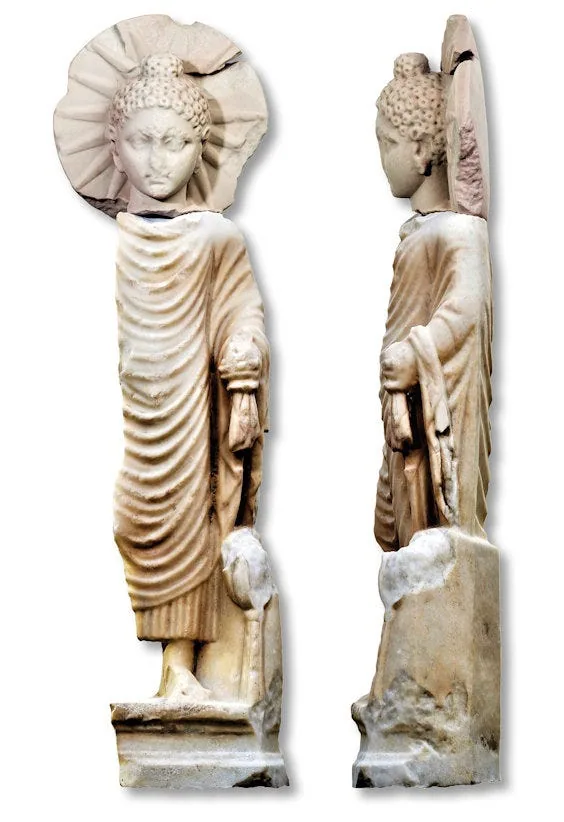
The statue, made from stone possibly quarried from the region south of modern Istanbul, Turkey, depicts the Buddha. Standing at 28 inches tall, the statue is an eloquent piece of craftsmanship. It shows Buddha in a standing posture, holding a fragment of his robes in his left hand. An intricately designed halo can be seen behind him, symbolizing his enlightened mind. Next to him stands a lotus flower, a frequent symbol in Buddhist iconography that represents purity and enlightenment. Remarkably, this statue is not an import but is believed to have been sculpted locally at Berenike, testifying to the existence of a community deeply influenced by Buddhist thought.
The Brahmi Sanskrit Inscription: A Message Across Time
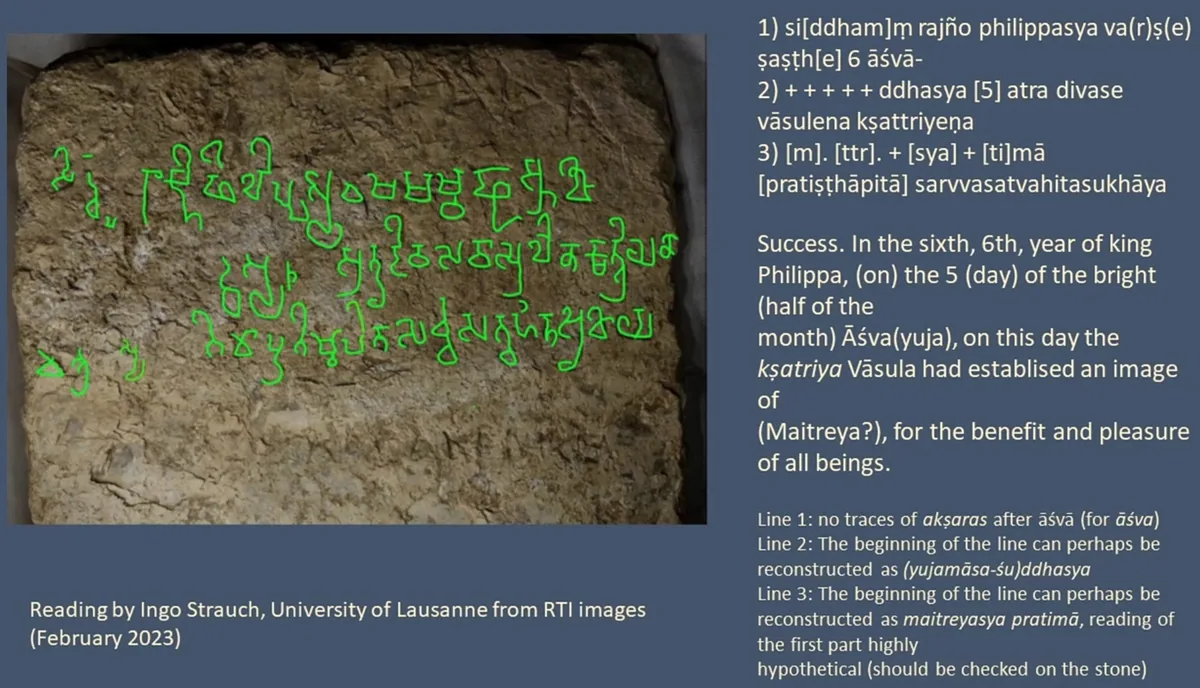
The second significant find is an ancient Sanskrit inscription written in the Brahmi script. Although damaged, the inscription appears to be a dedication of some sort and is dated back to the reign of the Roman emperor Marcus Julius Philippus, better known as “Philip the Arab,” who ruled from A.D. 244 to 249. It mentions a Kshatriya named Vasula, who seems to have been instrumental in establishing or gifting the Buddha statue during the 6th regnal year of Philip the Arab. This inscription is a remarkable piece of evidence not just for what it says but also for its very existence: it is the first-ever Sanskrit inscription to be found in Egypt.
These discoveries opened up new avenues of inquiry into the nature of cross-cultural interactions and the extent of maritime trade between India and the Roman Empire. However, the true significance of these finds extends beyond mere historical curiosity; they serve as tangible proof of a rich, shared past that has yet to be fully explored.
The Significance of the Berenike Finds
Naming a Roman King in Sanskrit The first layer of significance in these discoveries lies in the Sanskrit inscription itself, specifically its explicit mention of a Roman king, “Philip the Arab.” This is groundbreaking for several reasons. For one, it serves as the first Sanskrit inscription ever found in Egypt, thereby adding a whole new geographical dimension to the spread of this ancient Indian language. Moreover, the naming of a Roman king in a Sanskrit inscription broadens our understanding of how intimately the Roman Empire and the Indian subcontinent were connected, not just economically, but politically and intellectually as well.
The Westernmost Buddha The Buddha statue holds its own unique importance, notably for being perhaps the westernmost artifact of its kind. The fact that the statue was dedicated “for the benefit and pleasure of all beings” accentuates the universalist ethos of Buddhism. The placement of such a statue, with such an inscription, at Berenike, lends further weight to the notion that the ideas of Buddhism had not only traveled but were being internalized in regions far from their place of origin.
More than Just Traders Passing Through The third layer of significance lies in the localization of this find. Given that the statue is believed to have been crafted locally in Berenike using materials possibly sourced from Turkey, this suggests more than just transient trading activities. It points to the existence of a settled community that not only facilitated trade but also engaged deeply with the cultural and spiritual aspects of the commodities they traded in. Such a community would have been instrumental in the spread of ideas, technologies, and spiritual philosophies between India, Africa, and the Roman Empire.
Satavahana Coins The discovery of coins from the Satavahana Empire furthers the narrative of extensive economic interaction between these civilizations. These coins serve as concrete evidence of mutual trade interests and suggest that the ancient world was much more globally connected than we often presume. It is not just an indicator of Indian traders going westward but also perhaps of Roman traders and explorers coming to India, leading to a two-way exchange of goods, services, and currencies.
Cultural Exchange Last but not least, these finds highlight the rich shades of cultural exchange that occurred through these trading routes. The Buddha statue and the Sanskrit inscription act as vivid markers of this exchange, encapsulating within themselves an amalgamation of Indian spiritualism, Roman political influence, and Egyptian hospitality. They reflect an era where cultures did not merely collide but coalesced, enriching each other in the process.
The finds at Berenike are not mere historical artifacts; they are keys to understanding a far more globalized ancient world than we have hitherto imagined. They shine a light on the confluence of commerce, politics, and spirituality that stretched across continents and civilizational boundaries, offering a richer, more nuanced narrative of human history.
In essence, Berenike beckons us to appreciate the power of cultural diffusion and the richness that comes from the amalgamation of different worlds. It shows us that history is not a series of isolated events, but a continuum of shared experiences. As we dig deeper into the earth to understand our past, we unearth lessons that are remarkably relevant for the present and the future.
That’s my learning for today!
Acknowledgement:
This post is inspired by this lecture by Shailendra Bhandare (Ashmolean Museum, University of Oxford) titled “Interesting Indic Finds from Berenike” : https://www.youtube.com/watch?v=6ku1YH1scQ8