Ancient → Modern
Rewriting Mathematical History: The Bakhshali Manuscript’s Revelations
The history of mathematics is rich with innovators who brought forth concepts and systems that revolutionized our understanding of the universe.

On this page
The history of mathematics is rich with innovators who brought forth concepts and systems that revolutionized our understanding of the universe. In India, the name Aryabhata often comes to mind when discussing the invention of zero, one of the most profound mathematical innovations. While Aryabhata’s contributions are indisputable, they might not be the starting point of this fascinating numeral. The Bakhshali Manuscript, a mathematical text that predates Aryabhata, offers compelling evidence that the concept of zero and other advanced mathematical ideas were in use in India much earlier.
Discovery
The Bakhshali manuscript, an ancient Indian mathematical text, was unearthed in 1881 near the village of Bakhshali, in what is now Pakistan. Initially thought to date back to the 9th century, recent radiocarbon dating suggests that it may be even older, with portions dating as far back as 224–383 AD. The manuscript has journeyed through time, surviving the fragility of its birch bark pages, and now resides at the Bodleian Library at the University of Oxford.
Significance
The manuscript, written in an early form of the Sharada script, reflects the linguistic diversity and richness of ancient India. The language of the script was supposed to be Sanskrit but included local influences from Buddhist and old Kashmiri words. The influence of local dialects in the text suggests a convergence of cultures and knowledge systems, indicative of a vibrant intellectual milieu.
The concept of Zero
The most revolutionary aspect of the Bakhshali manuscript is arguably its use of zero. The manuscript contains the earliest known instance of zero represented as a dot, used as a placeholder in the positional numeral system.

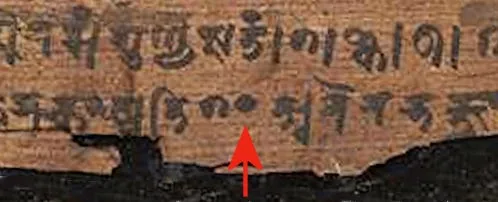
This representation of zero is groundbreaking. It predates other known instances of zero in the Indian subcontinent, pushing back the timeline of this critical mathematical concept’s development.
The use of zero in the manuscript is not just symbolic; it’s functional. It demonstrates a sophisticated understanding of zero both as a placeholder and as a concept. This understanding is foundational to modern mathematics, particularly in the development of algorithms and computational methods.
Philosophical implications of Zero (and its opposite, infinity) are significant in the Indian context. I blogged about this earlier here. It resonated with the philosophical concepts of emptiness and the void found in Indian metaphysics, illustrating the interconnectedness of science, philosophy, and spirituality in ancient Indian thought.
Problems and Solutions
The Bakhshali manuscript is an amalgamation of mathematical principles and examples presented in verse, accompanied by prose commentaries. Generally, each section starts with a mathematical rule, followed by one or more examples. For each example, the manuscript sets out the numerical data in a tabular format, known as “nyāsa” or “sthāpanā.” This is then followed by a detailed computation that methodically applies the given rule step by step, often referencing the rule itself. The process concludes with a verification step to ensure the solution accurately addresses the problem.
The manuscript includes algorithms and techniques for solving a diverse array of mathematical problems. These include systems of linear and quadratic equations, arithmetic progressions, and geometric series. It also details methods for approximating square roots, addresses the concept of negative numbers in the context of profit and loss, and even delves into practical applications like measuring the purity of gold.
Example problems:
- One person possesses seven asva horses, another nine haya horses, and another ten camels. Each gives two animals, one to each of the others. They are then equally well off. Find the price of each animal and the total value of the animals possessed by each person.
- Two page boys are attendants of a king. For their services, one gets13/6dinaras a day and the other3/2*. The first owes the second10dinaras. calculate and tell me when they have equal amounts.*
(Try solving them for fun. If you want solutions, they are in one of the reference links below :)
Chronicle of Intellectual Endeavor
The Bakhshali manuscript is more than a historical curiosity; it’s a chronicle of intellectual endeavor. Its contents highlight the advanced mathematical concepts that were in play well before the time of Aryabhata. The use of zero as a placeholder and as a concept in this manuscript rewrites a chapter of history, illustrating that the understanding and usage of zero were prevalent in India much earlier than previously believed.
The manuscript stands as a testament to India’s legacy as a cradle of mathematical thought, pushing back the dawn of the zero and enriching our understanding of the global narrative of mathematics. It embodies the continuum of knowledge, from the ancients to the present, and underscores the timeless quest of human intellect to unravel the mysteries of the universe: a quest that resonates profoundly with the ethos of Indian philosophy and the search for cosmic order.
That’s my learning for today!
More reading:
Bakhshali manuscript - Wikipedia