Ancient → Modern
Meluhha to Mesopotamia: Sailing Westward
In past articles, we’ve delved into India’s rich history of trade with far-off civilizations like Rome and Egypt.
On this page
In past articles, we’ve delved into India’s rich history of trade with far-off civilizations like Rome and Egypt. We’ve navigated through ancient ports like Benerike and understood the fascination with Indian spices and gemstones that reached distant lands. Today, we’ll rewind time to explore what could be the first trade connection between ancient India and a Western civilization, Mesopotamia. Buckle up, as we set sail from the Indus Valley ports to Mesopotamia, crossing both time and oceans.
Embarking on an Ancient Adventure
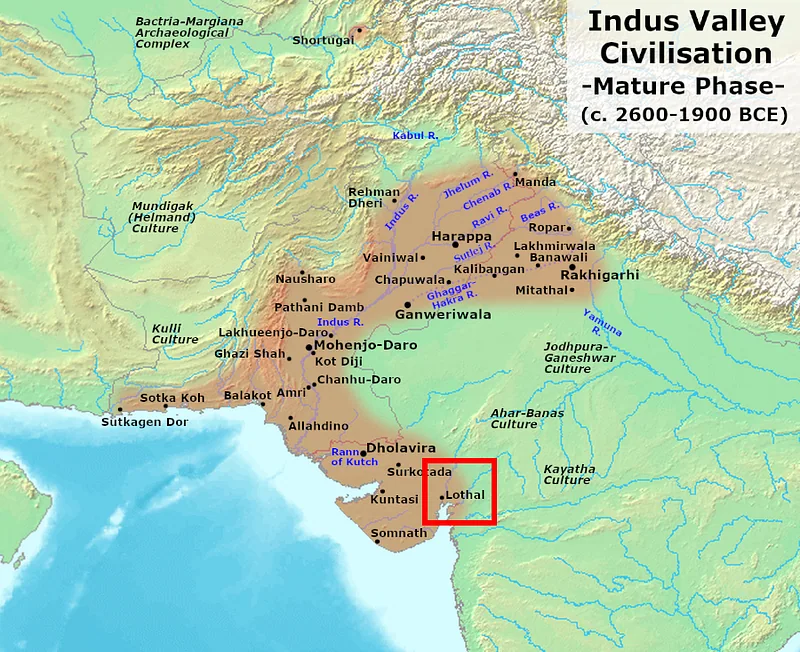
Picture this: You’re standing on the docks of Lothal, a bustling port city in the Indus Valley. The year is **2500 BCE.**The atmosphere is electric, merchants shout out last-minute orders, sailors secure cargo onto wooden ships, and artisans give finishing touches to their goods. You’re not just any spectator; you’re part of this world. You’re an Indus Valley trader, and you’ve got a ship to catch, a ship that’s loaded with some of the most exquisite goods this civilization has to offer.
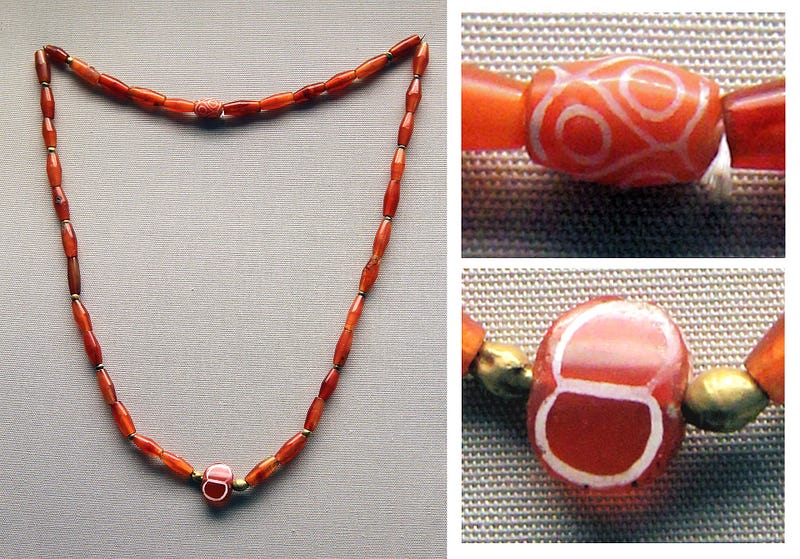
In your cargo hold, there are bright red carnelian beads, polished to perfection, each bead reflecting the artisanal mastery of your people. Bundles of deep-blue Lapis Lazuli are carefully stacked, a luxurious item that can fetch a small fortune in far-off lands. Ivory, gleaned from the majestic elephants of the subcontinent, adds a touch of opulence. Timber, Gold, spices like peppercorns and cardamom, and possibly even early forms of cinnamon, fill the remaining space.
Your ship leaves Lothal, setting its course westward. You navigate cautiously along the coast of what we today know as Iran and Oman, feeling a mixture of anticipation and apprehension. You’ve heard tales of Mesopotamian ports like Ur and Uruk, and you wonder what awaits you there. As the coastline fades into the horizon and you hit the open sea, there’s no turning back. Your journey, laden with both risks and promises, has truly begun.
Mesopotamia and the Promise of Meluhha
Your ship finally approaches **Mesopotamia, “The Land Between the Rivers.”**As you disembark, you’re struck by the stark contrast between your home and this new world. Unlike the Indus Valley, with its carefully planned cities and sophisticated drainage systems, Mesopotamia is a cluster of city-states: each governed by its own set of rules and leaders.
The Mesopotamians have developed cuneiform writing, are skilled astronomers, and their ziggurats, or temple towers, dominate the skyline, symbolizing their devotion to the gods. It’s a civilization deeply entrenched in myths and religious rituals, a society that, like yours, has complex social hierarchies and a bustling economy.
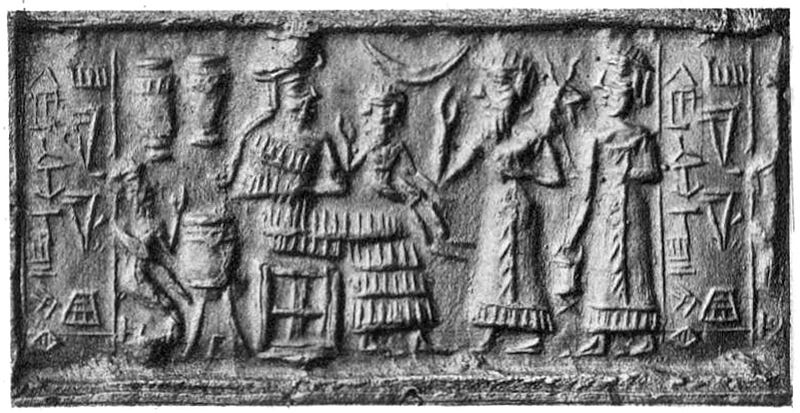
Here, in Mesopotamia, you hear the word “Meluhha” whispered with a sense of awe and reverence. Among the Mesopotamians, Meluhha is an exotic land, a land of riches and marvelous goods. The scribes and merchants often talk about it, and it’s even mentioned in their cuneiform tablets. But what is Meluhha? Based on archaeological evidence and historical texts, scholars today strongly believe that Meluhha is none other than the Indus Valley.
Exchanging Goods and More
As you start trading, you notice something incredible, the Mesopotamians seem familiar with your goods. It turns out they’ve been craving the deep-blue Lapis Lazuli, the intricate carnelian beads, and the fine spices you’ve brought. Various figurines of exotic animals in gold are an elite attraction. But it’s not just a one-way trade. They offer you Mesopotamian goods like wool, grains, and finely crafted metal objects. You also notice Mesopotamian seals, similar to the ones you’ve seen back in the Indus Valley. Could it be that the ties between these two civilizations go deeper than you initially thought?
As your days in Mesopotamia pass, you realize that your journey is not just about trading goods. It’s also about exchanging cultural motifs, sharing technological advances, and perhaps even adopting similar ways of seeing the world.
As you set sail back to the Indus Valley, your ship laden with new goods and your heart filled with experiences, you can’t help but marvel at the power of human exploration. Your journey wasn’t just a commercial enterprise; it was a testament to the innate human desire to explore, to seek out the unknown, and to build connections that transcend geographical and cultural boundaries.
The links you’ve helped forge between the Indus Valley and Mesopotamia will serve as a precursor to future Indian civilizations trading with the Greeks, Romans, Egyptians, and beyond. The sea routes and trading practices developed now will be refined, expanded, and will stand the test of time. What began as an adventurous gamble will evolve into the Silk Roads and maritime trade routes that shape global history.
That’s my story for today!