Ancient → Modern
From Rigveda to Research: Parallels Between Nasadiya Sukta and the Big Bang
Throughout history, human beings have looked up at the stars and wondered about the origins of the universe.
On this page
Throughout history, human beings have looked up at the stars and wondered about the origins of the universe. This curiosity has manifested in a multitude of creation myths and stories that echo across cultures, giving shape to our ancestors’ cosmological understandings. From the Egyptian tales of Atum emerging from the primordial waters to form the world, to the Greek chronicles of Chaos giving rise to the cosmos, or the Mesopotamian Enuma Elish where the heavens and the earth are birthed from the division of the slain Tiamat, and even the Chinese Taoist tales where the Yin and Yang emerged from the Wuji to craft the world: each narrative encapsulates a society’s attempt to fathom the vastness of the cosmos.
Yet, as we delve deeper into these stories, an ancient Indian scripture, the Nasadiya Sukta from the Rigveda, stands out with a uniqueness that resonates profoundly with our modern understanding. Unlike many ancient myths, which often begin with a deity or an act of divine will, the Nasadiya Sukta embarks on a journey of speculative inquiry, pondering the very nature of creation and the mysteries of what might have existed before. This approach, more philosophical than mythical, intriguingly aligns with today’s Big Bang Theory: a scientific concept describing the birth of the universe from a singularity, evolving and expanding over time.
As we prepare to navigate the parallels between this Vedic hymn and the Big Bang Theory, let’s appreciate the timeless human endeavor to understand our cosmic origins, and how an ancient Indian text, thousands of years old, might come closer to modern cosmological thought than we ever imagined.
The Big Bang:
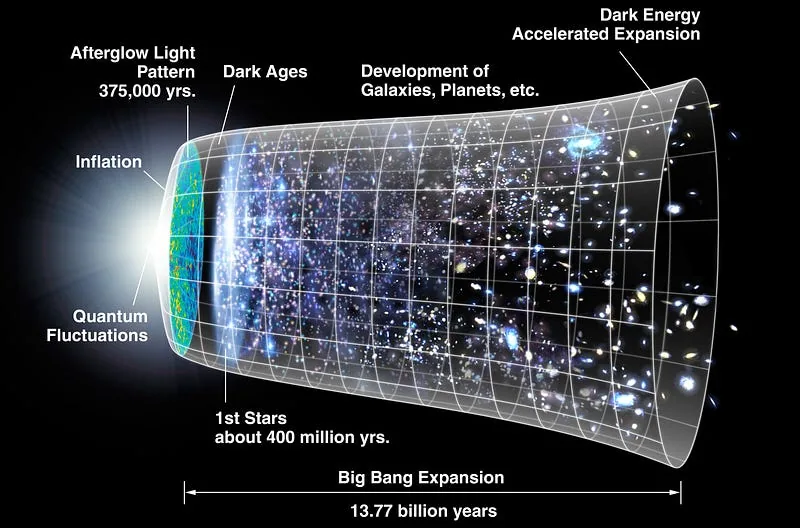
At its core, the Big Bang Theory posits that the entirety of our universe, once upon a time, was concentrated into a singular, incredibly tiny point. This minute point, immeasurably hot and dense, expanded, giving birth to the universe we observe today.
Origin of the Big Bang Theory:
- Albert Einstein’s Theory of Relativity: The seeds of the Big Bang Theory can be traced back to the early 20th century. Einstein’s equations of general relativity, introduced in 1915, provided a new framework for understanding the universe’s large-scale structure. However, initially, even Einstein believed in a static universe and introduced the “cosmological constant” to counteract the effects of gravity and ensure a static universe. This would later be seen by Einstein as a mistake.
- Georges Lemaître and the Expanding Universe: In 1927, Georges Lemaître, a Belgian astronomer, proposed that the universe was expanding. Using Einstein’s equations, Lemaître suggested that if the universe is expanding currently, then it must have originated from a single point or “primeval atom.”
- Edwin Hubble’s Observations: In 1929, Edwin Hubble made a groundbreaking observation using the Hooker telescope. He noticed that galaxies were moving away from us and that the farther away a galaxy was, the faster it was receding. This observation of redshifts in the light from galaxies provided direct evidence for an expanding universe, reinforcing Lemaître’s idea.
Key Moments in the Universe’s Evolution:
- Initial Singularity: Our universe was initiated from a singular state, an incredibly compact and hot point. This is a state where our contemporary understanding of physics is challenged. This is one of the greatest mysteries to be solved.
- Rapid Expansion: Post its inception, the universe underwent a significant phase called “inflation.” During this brief period, it expanded at an unfathomable rate, much faster than light.
- Formation of the Basics: As the universe cooled down, foundational elements started taking shape. Within just three minutes, basic elements like hydrogen and helium emerged.
- Galaxies, Stars, and More: Over the subsequent millions of years, these fundamental components began to coalesce, leading to the creation of stars, galaxies, and eventually, planetary systems.
- Ongoing Expansion: The universe’s growth didn’t cease: it persists in expanding. Modern tools and observational techniques continue to provide insights into this process, allowing us to understand our universe’s past and anticipate its future.
The Big Bang Theory, founded upon rigorous scientific observation and inquiry, paints a vivid picture of the universe’s infancy. While the specifics of this theory are relatively recent in the vast timeline of human history, the essence of such inquiry (the pondering over beginnings, over the nature of existence, and the mysteries that preceded it) finds an echo in the ancient verses of the Nasadiya Sukta.
Nasadiya Sukta:
The Nasadiya Sukta is one of the most celebrated and philosophically profound hymns in the Rigveda, an ancient collection of Sanskrit hymns that form the oldest of the Vedas, the sacred scriptures of Hinduism. The Nasadiya Sukta (often referred to as the “Hymn of Creation”) is found in the 10th Mandala (Book 10) and is designated as Hymn 129. It contemplates the origins and mysteries of the cosmos and existence itself.
The Nasadiya Sukta consists of seven verses. The hymn begins by pondering what existence might have been like “in the beginning,” before the existence of the known universe.
Translation of Nasadiya Sukta (Rigveda)
Then even nothingness was not, nor existence,
There was no air then, nor the heavens beyond it.
What covered it? Where was it? In whose keeping?
Was there then cosmic water, in depths unfathomed?
Then there was neither death nor immortality
nor was there then the torch of night and day.
The One breathed windlessly and self-sustaining.
There was that One then, and there was no other.
At first there was only darkness wrapped in darkness.
All this was only unillumined cosmic water.
That One which came to be, enclosed in nothing,
arose at last, born of the power of heat.
In the beginning desire descended on it –
that was the primal seed, born of the mind.
The sages who have searched their hearts with wisdom
know that which is kin to that which is not.
And they have stretched their cord across the void,
and know what was above, and what below.
Seminal powers made fertile mighty forces.
Below was strength, and over it was impulse.
But, after all, who knows, and who can say
Whence it all came, and how creation happened?
the Devas (minor gods) themselves are later than creation,
so who knows truly whence it has arisen?
Whence all creation had its origin,
he, whether he fashioned it or whether he did not,
he, who surveys it all from highest heaven,
he knows, or maybe even he does not know.
(Nasadiya Sukta, translated from the original Sanskrit by A.L. Basham)
The Nasadiya Sukta & Big Bang Theory in Parallel:
Let’s journey through a side-by-side comparison, mapping the intricate verses of the Nasadiya Sukta with the pivotal events of the Big Bang Theory, to explore how ancient contemplation mirrors modern cosmological understanding:
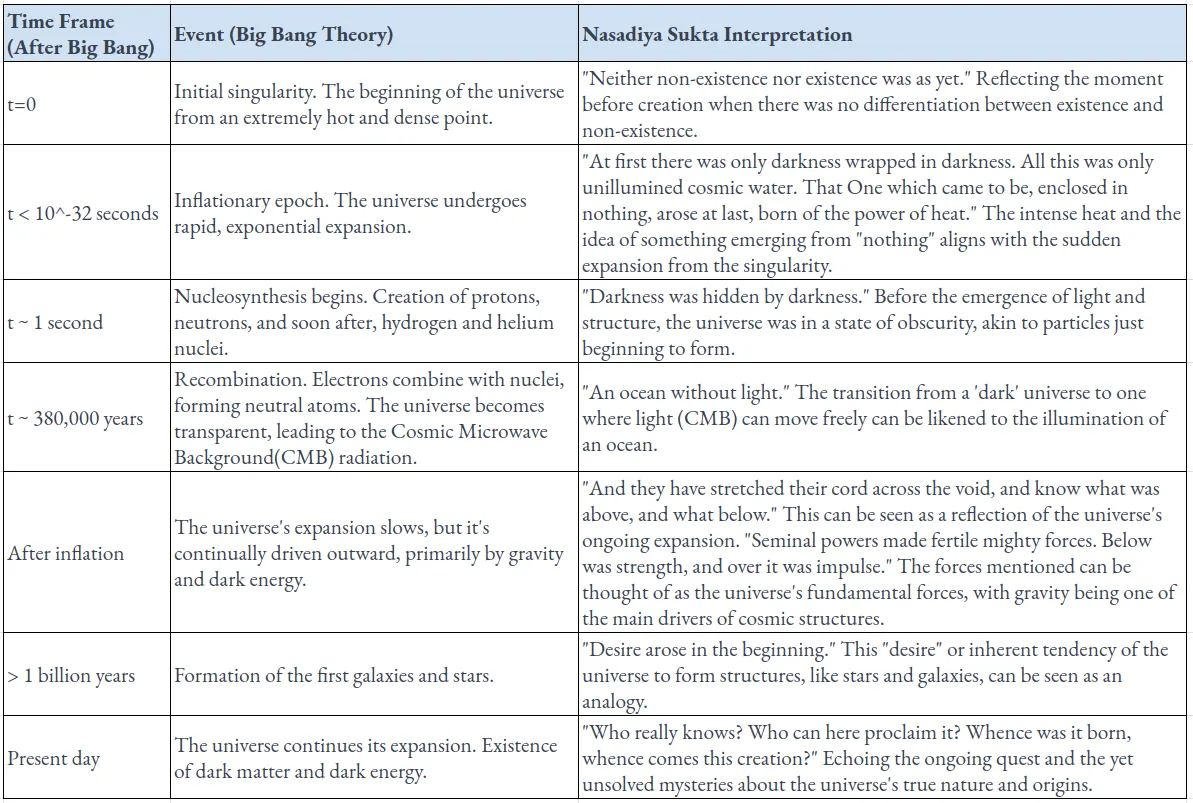
Navigating through this table, we witness an extraordinary confluence where millennia-old Vedic verses resonate with the meticulous observations of modern science. While one stems from profound spiritual introspection and the other from empirical research, both the Nasadiya Sukta and the Big Bang Theory illuminate our perennial quest to understand the universe’s genesis.
The Harmonic Dance of Ancient Wisdom and Modern Science
The Nasadiya Sukta, with its profound musings, invites us into a contemplative realm where philosophy and science seem to intertwine. This Vedic hymn does not present a linear, assertive narrative of creation. Instead, it ventures into the realm of the speculative, urging readers to reflect upon the enigmatic origins of the universe. Its verses ponder the very essence of existence, and in a striking parallel to the mysteries of quantum physics and cosmology, the Sukta raises questions that challenge even our most fundamental understandings.
Perhaps one of the most intriguing aspects of the Nasadiya Sukta is its candid acknowledgment of the unknown. It muses on the possibility that even the creator, the primal force behind all existence, might be unaware of how it came into being. “Who really knows? Who will here proclaim it? Whence was it produced? Whence is this creation?” The Sukta’s willingness to embrace uncertainty, to acknowledge the vast expanse of what remains unknown, is both humbling and enlightening. In an era where divine proclamations were often taken as absolute truths, the grand old Rigveda dared to express doubt, underscoring the vastness of the cosmic mystery.
As we stand at the crossroads of time, gazing back at the wisdom of our ancestors and looking forward to the horizons of future discoveries, it’s imperative to recognize the spirit of the Nasadiya Sukta. It embodies an essence that is fundamental to the human journey of knowledge, the spirit of questioning, of being speculative, and of harboring an insatiable curiosity. This spirit, deeply embedded in Vedic philosophy, mirrors the very ethos of scientific research.
In an age teeming with information, where answers are often at our fingertips, the Nasadiya Sukta reminds us of the value of pondering, of dwelling in the unknown, and of seeking with humility. As we continue our relentless quest for truth, may we be inspired by the Vedic sages, recognizing that it is in the dance of questions and reflections that true understanding is born.
That’s my musing for today!