Ancient → Modern
From Pune Potters to British Surgeons: The Story of Nose Jobs
The concept of interconnected knowledge can be envisioned as a vast, invisible web, each thread contributing to the strength and integrity of the whole.
On this page
The concept of interconnected knowledge can be envisioned as a vast, invisible web, each thread contributing to the strength and integrity of the whole. Think of rhinoplasty, or nose jobs, as more than just a modern-day cosmetic fix. It’s a practice with roots that go way back, connecting different parts of the world and showcasing how people shared smart ideas long before the internet. This story of nose reconstruction travels from ancient Egypt, swings by India, and makes its way into European operating rooms. What’s really cool is that it’s not just about how the surgery itself evolved, but also about how people learned from each other across time and space. It’s a glimpse into how a simple, yet important, idea can be passed along, improved upon, and continue to make lives better.
The Egyptian Prelude
The story kicks off in ancient Egypt, where people were already pretty savvy about medicine. They didn’t have nose jobs as we know them, but they were trying to figure out how to fix broken noses. The Edwin Smith Papyrus, one of the oldest known medical texts, talks about treating nose injuries. While the Egyptians didn’t quite have rhinoplasty down, they were onto something: the idea that you could, and should, try to fix physical issues, not just live with them. It’s like they planted the seed of an idea that would grow and evolve as it traveled to different parts of the world.
An Idea Takes Root in India
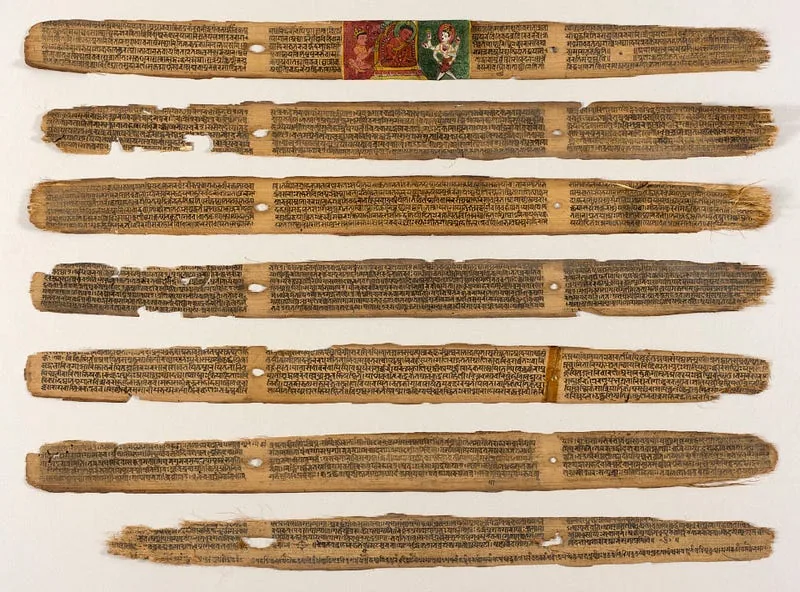
From the lands of the Pharaohs, we journey to ancient India. In the treatise ‘Susruta Samhita,’ written around the 6th century BCE, the sage Susruta offers an astonishingly detailed account of nose reconstruction techniques. This wasn’t mere theory; these procedures were regularly practiced. Astonishingly, even potters, common artisans in society, were trained to perform these surgeries. Imagine that, someone who makes clay pots by day might also help you get a new nose by evening! This wasn’t specialized knowledge locked away in some secret society; it was community knowledge. It shows us how in ancient India, useful skills and information were spread wide, enriching the lives of everyone, not just a select few.
The technique involved taking a flap of skin from the forehead or cheek and artfully grafting it to form a new nose, closely resembling the procedure used in the Cowasjee case many centuries later. Thus, the soil of India nurtured a medical practice that would later blossom in different parts of the world.
The Arab Conduit
Fast forward a bit, and we see this ancient Indian knowledge get picked up by Arabic scholars. These scholars were like the internet search engines of their day, collecting and translating all kinds of texts from different places, including India. People like Avicenna and Al-Razi took this knowledge and added their own insights, sort of like hitting the “share” button but with a thoughtful comment. Because of their work, this Indian technique of nose reconstruction didn’t just stay in India: it was documented in Arabic, which acted like a bridge to the Western world.
The Intriguing Tale of Cowasjee: A Story Within a Story
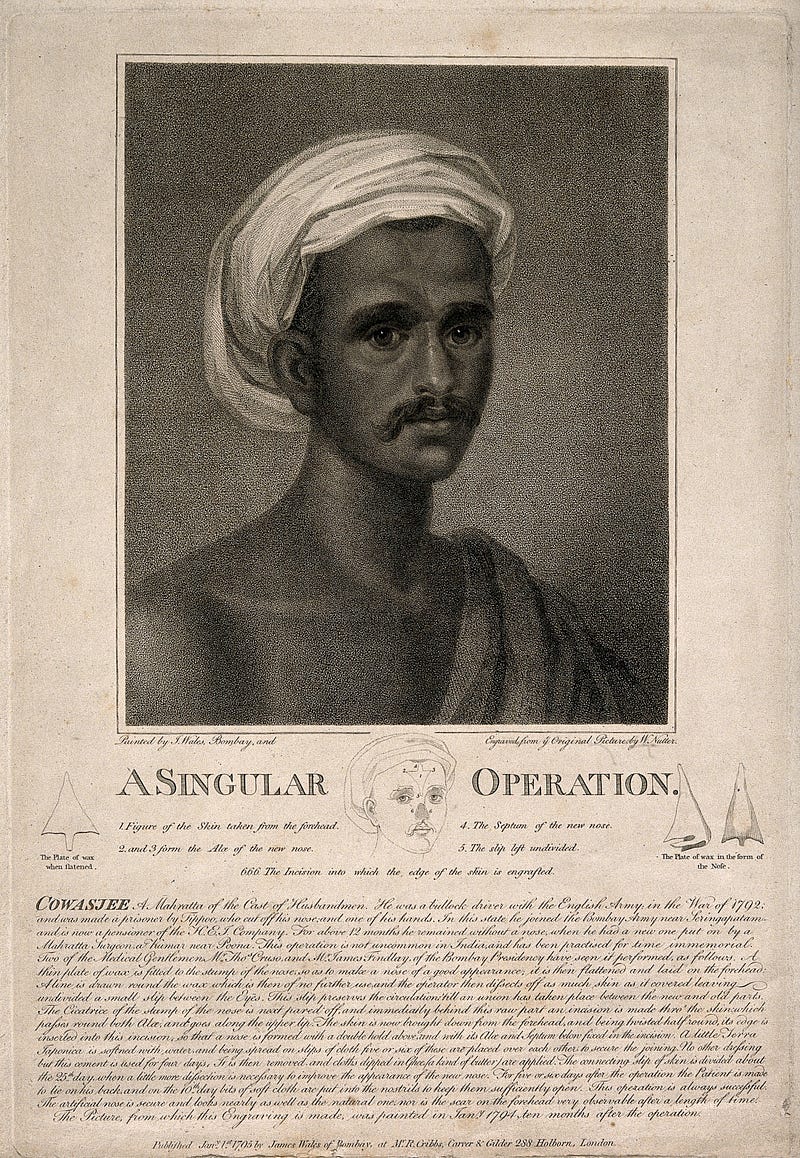
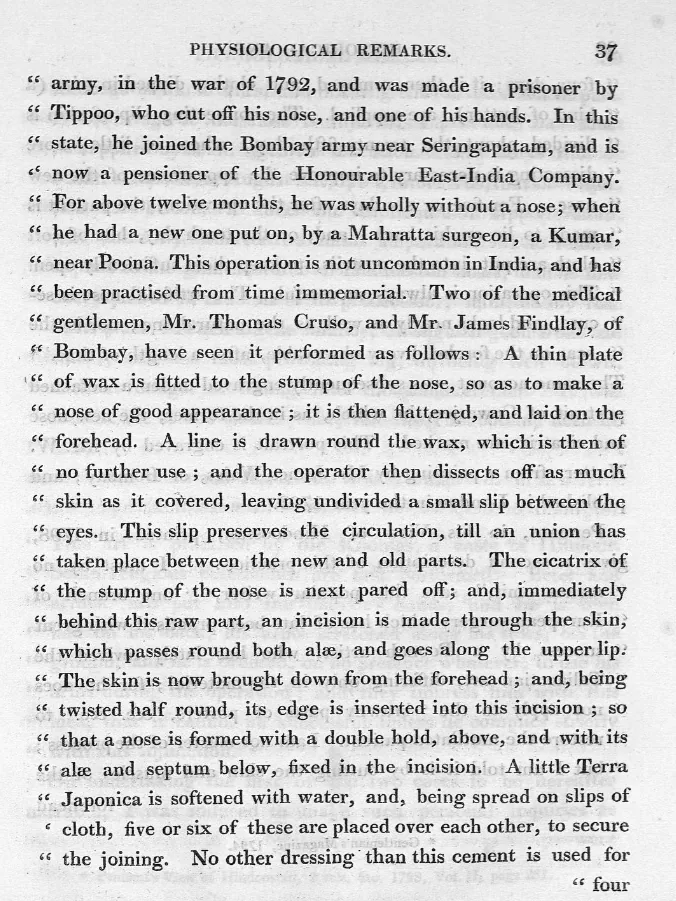
Cowasjee’s life reads like a dramatic tale of resilience, survival, and fortuity that helped bridge worlds. He was a bullock cart driver serving the English forces in India. During his service in the year 1792, he was captured by Tipu Sultan’s army. Tipu, also known as the Tiger of Mysore, was known for his strict form of justice and punishment. Cowasjee found himself on the wrong end of this justice: he was subjected to the brutal removal of his nose and arm as a punitive measure.
He lived in this disfigured state for almost a year, an enduring testament to the hardships of war and the unforgiving hand of fate. Yet, his story takes a turn when he arrived in Pune, a city renowned for its skilled potters. Now, these weren’t just any potters; these were potters trained in an ancient surgical art form passed down from the times of the ‘Susruta Samhita.’ Cowasjee, perhaps hesitant but undoubtedly desperate, decided to undergo the surgical procedure.
The potter applied the age-old technique of skin grafting, which involved taking a flap of skin from Cowasjee’s forehead to reconstruct his missing nose. The operation was a success, a triumphant moment both for Cowasjee and for the perpetuation of this ancient wisdom. He was no longer just a disfigured soldier; he had become a living testament to a surgical tradition that had weathered the sands of time.
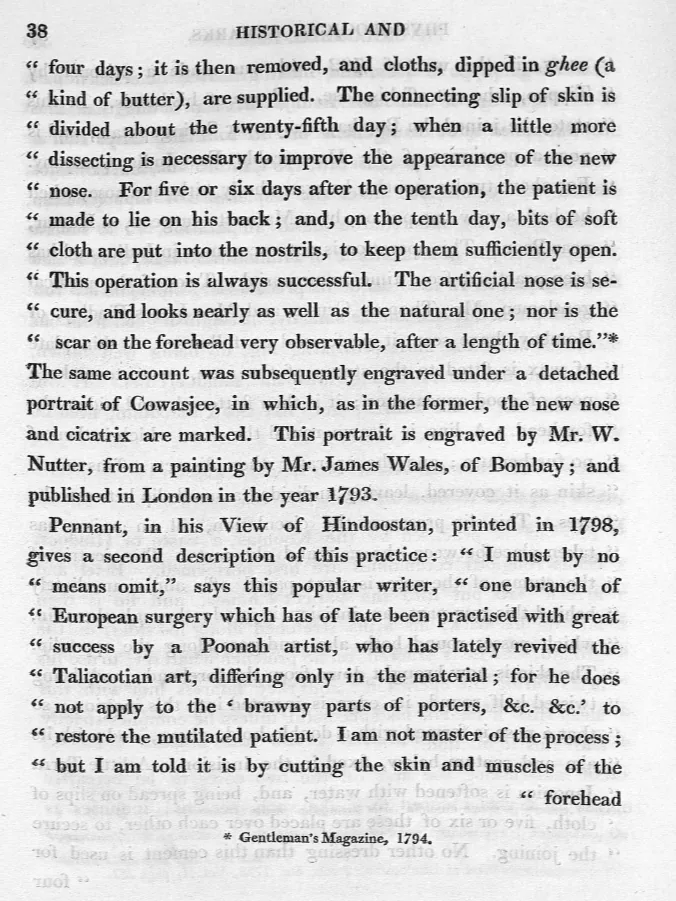
However, the tale doesn’t end here. Two of the British medical personnel, who witnessed the operation, ported the incredible transformation story to British colonial circles. British physicians, always keen to discover new techniques, were fascinated. They thoroughly examined Cowasjee and corroborated the story. It wasn’t long before the tale of Cowasjee and his new nose was documented and sent to Europe. Journals like the “Gentleman’s Magazine” publicized his story in 1794, making it a subject of intrigue and study across the seas.
European surgeons, most notably Joseph Constantine Carpue, were riveted. He saw not just a man with a newly constructed nose but a gateway to a whole new world of surgical possibilities. Carpue took the plunge and tried replicating this surgical marvel in England, drawing directly from the detailed accounts that revolved around Cowasjee. And just like that, the wisdom contained in an ancient Indian text and practiced by humble potters in India had leapfrogged into the medical annals of the European world.
Often, the narratives of scientific and medical breakthroughs are constructed within a Eurocentric framework, almost as though all roads of innovation lead back to Europe. However, some pioneers have endeavored to set the record straight, recognizing that the spread of knowledge is not a one-way street. Joseph Constantine Carpue was one such individual. He was captivated by the story of Cowasjee and the age-old technique of rhinoplasty originating from India.
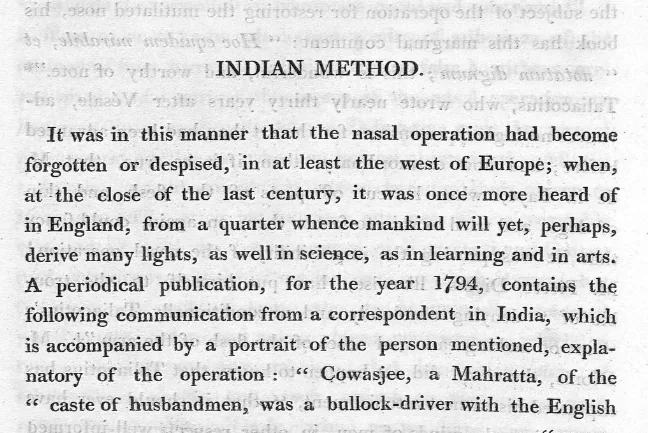
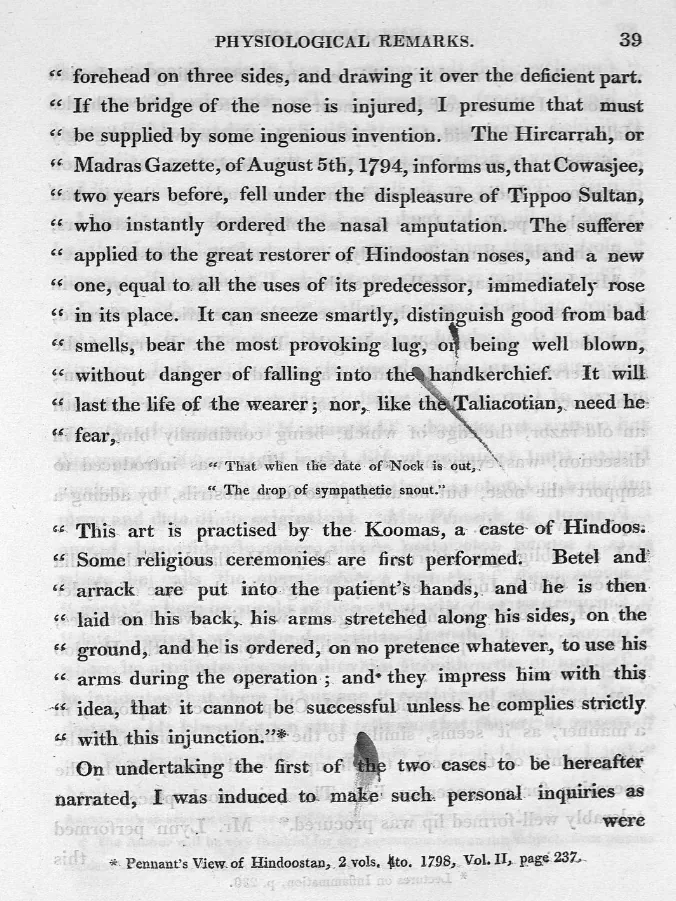
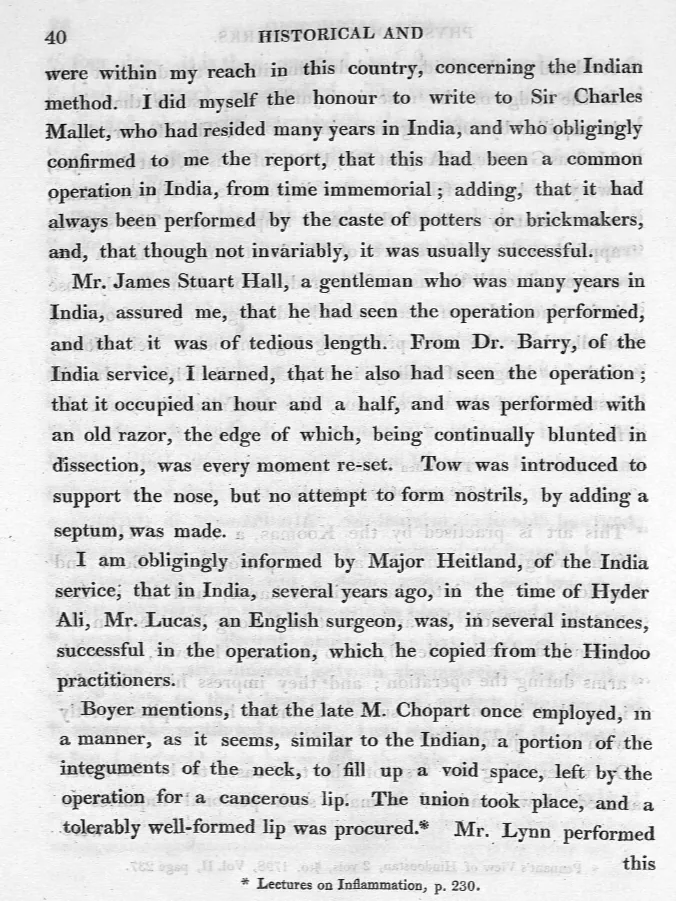
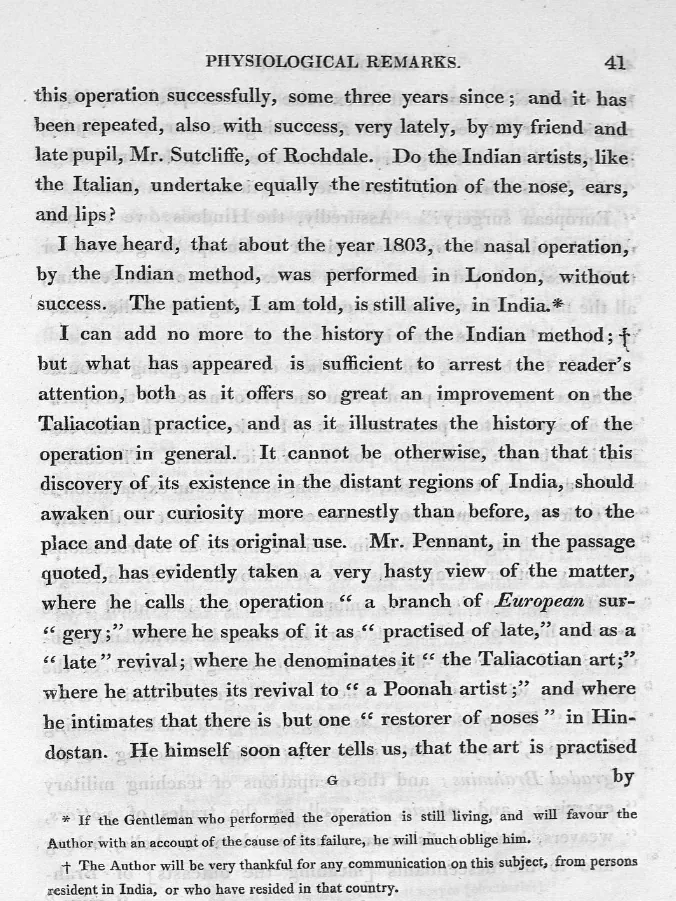
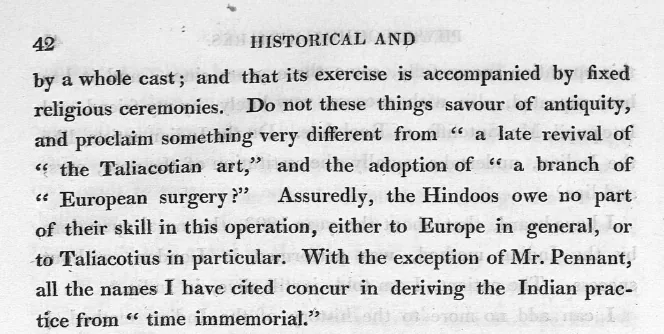
In his work, “An Account of Two Successful Operations,” Carpue takes a moment to correct a prevailing misconception. He explicitly states that Indians didn’t “owe” this surgical technique to Europeans, as some of his contemporaries seemed to imply. On the contrary, Carpue honors the Indian heritage of this practice, acknowledging that it had been a part of Indian medical tradition “from time immemorial.”
Below are screenshots from the above book where he talks about Indian Method.
Modern Rhinoplasty
The journey of rhinoplasty didn’t stop with Cowasjee or Carpue. Today, this procedure has evolved into a complex and precise form of surgery, using state-of-the-art technology and techniques that ancient potters could only dream of. But what’s interesting is that the core principle remains the same: taking skin from one part of the body to reconstruct another. It’s a testament to the enduring power of shared knowledge and the benefits of cross-cultural exchange.
If you look at medical textbooks today, you’ll see procedures that are clearly more advanced but still have that ancient wisdom running through them. It’s like a thread connecting the past and present, showing that no matter how advanced we become, there’s always something valuable to be learned from those who came before us.
The Endless Cycle of Knowledge Exchange
So what does this fascinating journey of rhinoplasty tell us? It’s not just a story about medical progress; it’s a tale of human collaboration and the flow of knowledge across cultures and eras. Ideas and wisdom aren’t confined by borders or time periods; they are living entities that grow, adapt, and find new homes where they are nurtured and further developed.
In a world that often emphasizes differences, the story of rhinoplasty serves as a poignant reminder of our shared human experience. From the potters of ancient India to the scholars of the Arab world, and finally to the medical theaters of Europe, this surgical technique, and the underlying philosophy of human betterment, has crossed oceans and centuries.
And perhaps that’s the most important takeaway: Knowledge is a shared treasure, a common inheritance that enriches us all. The potters and physicians of yesteryears may never have known that their practices would echo through the annals of history, influencing and improving lives far removed from their own time and place. But isn’t that the essence of human progress? To contribute to a continuum of wisdom, one that not only honors the past but also empowers the future.
This tale of rhinoplasty, then, is more than just a surgical timeline; it’s a mirror reflecting the limitless possibilities that await us when we open ourselves to learning, sharing, and collaborating across the vast tapestry of human existence.
That’s my learning for today!