Ancient → Modern
Evolution of India’s Natural Philosophy and Engineering Marvels
In an ancient land, where the misty Ganges flowed and the colossal Himalayas stood guard, the nascent seeds of knowledge were sown.
On this page
In an ancient land, where the misty Ganges flowed and the colossal Himalayas stood guard, the nascent seeds of knowledge were sown. As the dawn’s first light touched the Indus Valley around 1500 B.C., With reverent sages meditating by rivers or under grand Banyan trees, this era witnessed a profound intermingling of spirituality, cosmology, and nascent scientific thinking.
The core texts from this epoch are the Vedas, primarily the Rigveda, Samaveda, Yajurveda, and Atharvaveda. While these texts are primarily religious, they carry an underlying exploration of the natural world. Hymns in the Rigveda, dedicated to deities like Agni (fire) and Varuna (water), delve into these elements’ properties and behaviors. Such verses subtly laid the foundation for understanding natural phenomena.
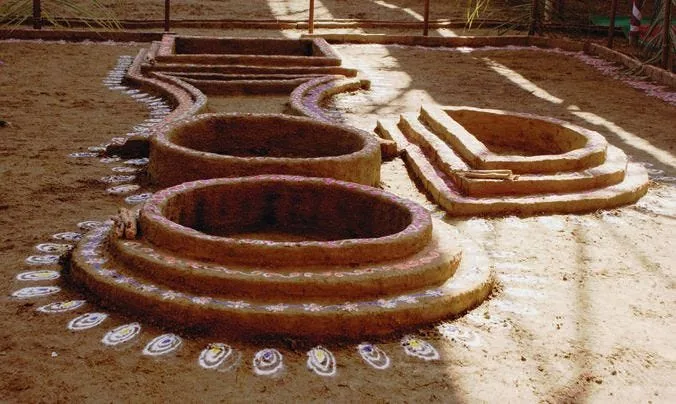
The Vedic sages were not just philosophers and meditators; they were also skilled mathematicians and engineers. The Shulba Sutras, an integral part of the Kalpa Vedanga, were essentially ‘rules of the cord’. These ancient Indian geometrical treatises laid out meticulous instructions on using ropes and measuring sticks to design ritualistic grounds. But the precision and complexity required went beyond simple measurements.
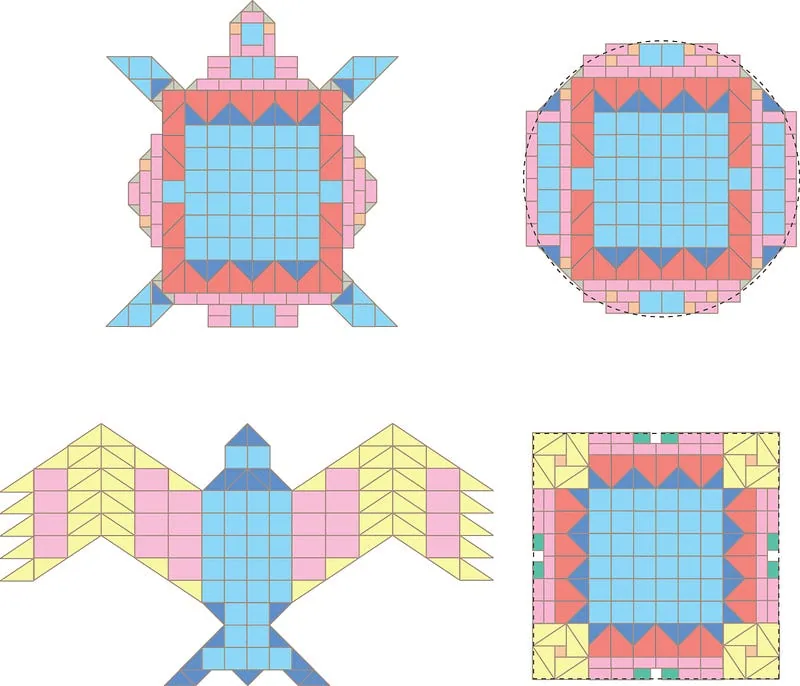
To construct the altars, or ‘vedis’, priests needed to transform squares into rectangles, triangles into circles, or create shapes with equal areas. These weren’t arbitrary requirements but carried symbolic spiritual meanings. For instance, the transformation of a square altar into a rectangular one represented the universe’s expansion. Such tasks necessitated an advanced understanding of geometry.
But the Shulba Sutras were not limited to geometry. They contained the roots of algebraic concepts as well. For instance, the approximation of the square root of 2 found in these texts showcases an early foray into irrational numbers.
This blend of geometry and algebra in the sutras provides an early glimpse of the Pythagorean theorem, several centuries before Pythagoras himself. Although the theorem’s formal proof came later, the knowledge of the relationship between the sides of a right triangle is evident in the sutras.
This was not just sacred geometry for ritualistic purposes but demonstrated practical applications of mathematical concepts. These techniques later evolved to influence the disciplines of algebra and geometry in subsequent periods.
The techniques and insights from the Shulba Sutras didn’t remain confined to the ritualistic altars; they permeated academic discussions and paved the way for subsequent mathematical developments in India.
Kanada and the Atomic Theory
As the sun of the 6th century B.C(?). rose over the Indian subcontinent, it shone on a period of unparalleled intellectual awakening. The fertile plains and dense forests became the backdrop for debates, discussions, and the genesis of profound philosophical ideas. The intellectual currents of the time gave birth to six distinct philosophical schools, each delving into life’s fundamental questions.
Among these philosophical paradises, one particularly stands out for its groundbreaking ideas that would eventually echo in the annals of scientific history, the Vaisheshika school. Its origins can be traced back to the sage Kanada, a visionary thinker whose name literally translates to “atom-eater”.
Kanada’s Glimpse into the MicrocosmVenture into an ancient gurukul (school), and you might find Kanada, lost in thought, breaking a piece of food into its tiniest components, reflecting on the fundamental nature of matter. This very act of subdividing matter led him to a radical proposition: that there exists a point beyond which substances cannot be further subdivided. He named these indivisible entities “Anu,” which means “the smallest”, what we modernly recognize as “atoms.”
In his profound work, the “Vaisheshika Sutras,” Kanada meticulously outlined his atomic theory. He postulated that these indivisible particles, when combined, form complex structures leading to the diverse materials we see around us. These ideas, although primitive, resonate intriguingly with the modern understanding of molecules and compounds.
Furthermore, Kanada’s sutras describe how atoms combine based on their inherent properties, hinting at a rudimentary understanding of chemical reactions. He believed that it was the combinations and permutations of these atoms that gave rise to the complexity of the material world.
Scholars like Aryabhata and Brahmagupta, who lived centuries later, possibly built upon the foundational knowledge encoded in these ancient texts. Their tales, woven between the lines of ancient manuscripts and astronomical tables, not only defined India’s scientific pursuits but also left an indelible mark on global intellectual history.
Aryabhata: The Astronomical Sage
In the dusky glow of a 5th-century Indian evening, a young scholar named Aryabhata gazed up at the starlit canvas above. From the ancient city of Kusumapura (modern-day Patna), he embarked on a celestial journey that would redefine Indian astronomy and mathematics.
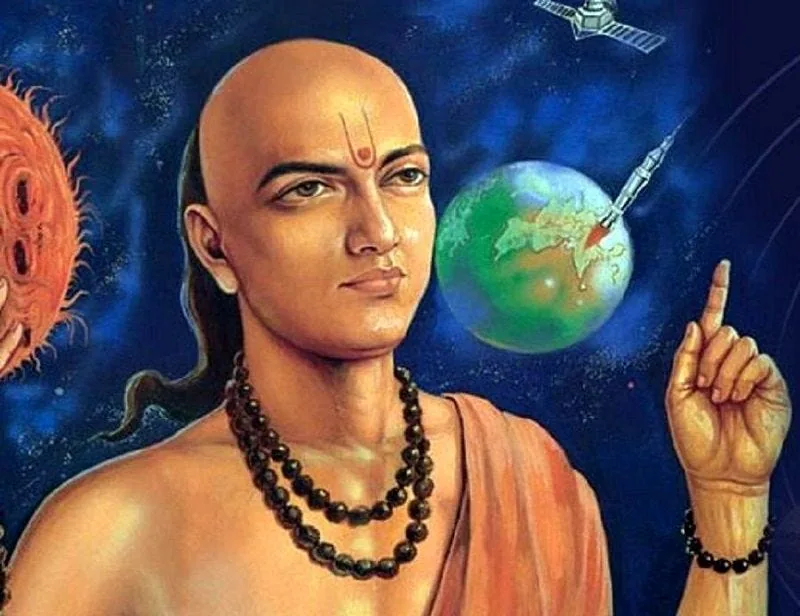
His magnum opus, the Aryabhatiya, was a compact yet comprehensive treatise on mathematics and astronomy. Aryabhata introduced the concept of ‘sine’ in trigonometry, paving the way for advanced astronomical calculations. More fascinatingly, at a time when the world believed in a flat Earth, Aryabhata’s writings hinted at a heliocentric universe and the Earth’s rotation.
His innovative method to calculate the value of π, which he approximated to 3.1416, showcased his mathematical prowess. Aryabhata’s insights laid the groundwork for the subsequent golden age of Indian mathematics.
Brahmagupta: The Mathematical Maverick of Ujjain
A couple of centuries later, the vibrant academic hub of Ujjain saw the rise of another genius: Brahmagupta. This prolific scholar’s contributions ranged from algebra, arithmetic, and geometry to astronomy.
In his seminal work, the Brahmasphutasiddhanta, Brahmagupta presented groundbreaking concepts. He was among the first to recognize zero as a number and elucidated its mathematical properties. Moreover, he ventured into the then-unchartered domain of negative numbers and even penned rules for arithmetic operations involving zero and negatives.
But his genius wasn’t confined to numbers alone. Brahmagupta’s work on geometry, especially his formula for cyclic quadrilaterals, predated European discoveries by several centuries.
The Metallurgical Marvels
‘Arthashastra’ penned by the renowned scholar Chanakya, carries detailed accounts of mining, metallurgy, and metalwork. The treatise elucidates the methods of extracting metals, smelting, and crafting intricate objects.
The zenith of this metallurgical expertise is the iconic Iron Pillar of Delhi. Located within the Qutub Minar complex, this 7-meter high pillar is an engineering marvel of its time. What makes it a subject of awe and scientific inquiry is its exceptional resistance to corrosion, remaining rust-free for over 1,500 years. Its composition, a testament to the sophisticated metallurgical methods employed, includes high phosphorus content that forms a protective barrier, preventing rusting.
The pillar isn’t just an artifact; it’s a symbol. A symbol of an era when Indian metallurgists, using techniques lost to time, achieved feats that modern science still grapples to fully understand.
The Architectural Ascendance
Parallel to the metal wonders, India’s architectural narrative was taking shape, echoing the subcontinent’s diverse cultures, traditions, and influences. This era saw the birth of the ‘Shilpa Shastras,’ ancient treatises on architecture and iconography. Guided by these scriptures, artisans transformed lifeless stones into living edifices.
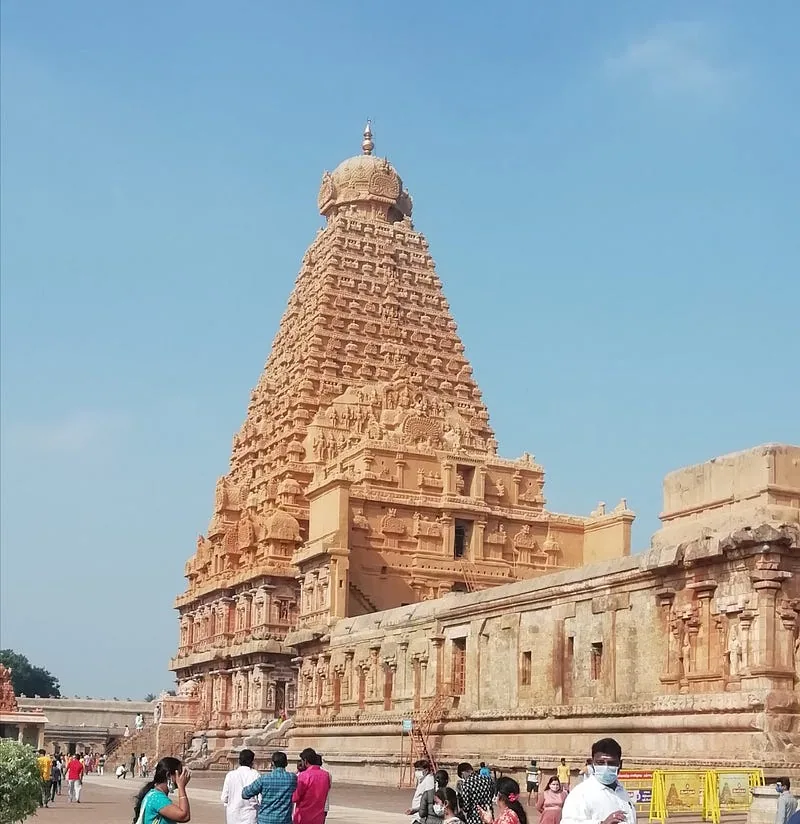
The architectural prowess can be witnessed in the meticulously planned cities of the Indus Valley, the rock-cut temples of the Deccan, the magnificent stupas of Sanchi, the wonder called Tanjavur temple, and the ornate palaces of Rajasthan. These structures, each a marvel, encapsulate India’s evolving design sensibilities, techniques, and materials.
One of the hallmarks of ancient Indian architecture was its symbiotic relationship with nature. Temples were often constructed in alignment with cosmic and terrestrial geometry. Water structures, like the stepwells of Gujarat and Rajasthan, were not merely functional but were designed as architectural wonders, integrating art, engineering, and hydrology.
The Kerala School of Mathematics
The Kerala School of Mathematics, spearheaded by luminaries like Madhava of Sangamagrama, ventured deep into the realms of mathematics and astronomy, with contributions that would astonish the world, though often under-recognized. During the 14th to 16th centuries, this coastal state became the cradle of a mathematical renaissance.
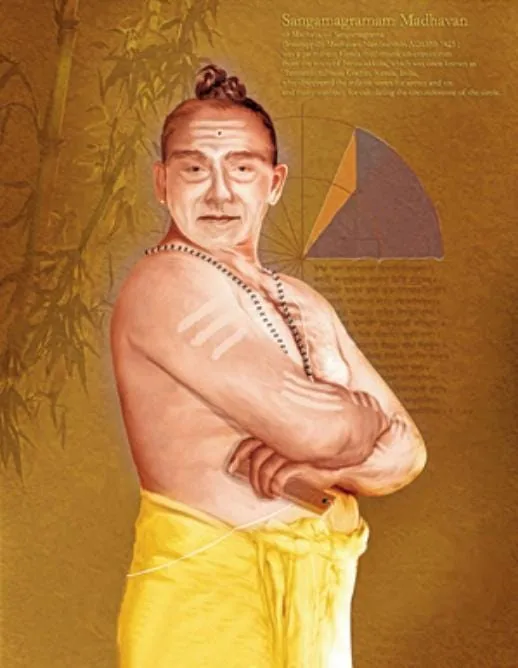
Madhava, often hailed as the founding father of the Kerala School, introduced path-breaking concepts in calculus. His series expansions for trigonometric functions, especially for sine, cosine, and arctangent, were precursors to the infinite series found in calculus. These pioneering insights predated European mathematicians like Newton and Leibniz by over two centuries.
Following Madhava, a lineage of prodigious scholars, including Parameshvara, Nilakantha Somayaji, and Jyesthadeva, continued the mathematical traditions. Nilakantha’s commentary on Aryabhata’s work offers an improved version of the planetary model. In contrast, Jyesthadeva penned the ‘Yuktibhasa,’ a unique work providing both mathematical proofs and algorithms, a rarity in Indian mathematics.
Land of the Learned
The tapestry of India’s rich scientific and philosophical legacy is interwoven with threads of innovation, introspection, and intellectual rigor. From the poetic hymns of the Vedas that hinted at a curious investigation into nature to the metallurgical masterpieces that defy time, India’s contributions span a broad spectrum of disciplines. The works of visionary scholars, from the geometric intricacies of the Shulba Sutras to the pioneering insights of the Kerala School, showcase a civilization that was constantly pushing the boundaries of knowledge. India’s legacy is not merely a testament to its past but a beacon for future generations, reminding us that the quest for knowledge knows no bounds. As we reflect upon these ancient marvels, we are reminded that the spirit of inquiry, innovation, and integration is timeless, and it is this spirit that has, and will continue to, shape the course of human civilization.