Ancient → Modern
A Journey Through India’s Age-old Water Wisdom
Water, often termed the “lifeblood of civilization,” has been at the core of societal development from the earliest of times.
On this page
- The Indus Valley Civilization: Blueprint of an Ancient Metropolis
- The Ahar-Pyne System: The Watershed Wisdom of Magadha
- The Dual Elements: Ahar and Pyne
- Baolis: The Underground Oasis of Rajasthan and Gujarat
- The Grand Anicut: Taming the Kaveri River with Chola Ingenuity
- Phad Irrigation: The Community-driven Water Wheels of Maharashtra
- Ancient Wisdom for Modern Water Woes
Water, often termed the “lifeblood of civilization,” has been at the core of societal development from the earliest of times. Long before modern plumbing and hydro-engineering, ancient communities had developed sophisticated systems to manage this vital resource. These systems were not just feats of engineering; they were testaments to the social cohesion and shared responsibility of the communities that built and maintained them. In India, this historical journey of water management reveals a narrative of ingenious methods adapted to diverse geographical landscapes and climatic challenges. In a time when water scarcity is a growing concern, we could glean some wisdom from our ancestors. This post will delve into these ancient techniques, highlighting not just the mechanics but also the communal spirit behind them.
The Indus Valley Civilization: Blueprint of an Ancient Metropolis
The Indus Valley Civilization, dating back to around 3300 BCE to 1300 BCE, sets a high standard for urban planning and public utilities, and water management was no exception. The cities of Harappa and Mohenjo-Daro were marvels of civil engineering. Streets were laid in a grid-like pattern, and alongside these streets ran covered drains that were light years ahead of their time.
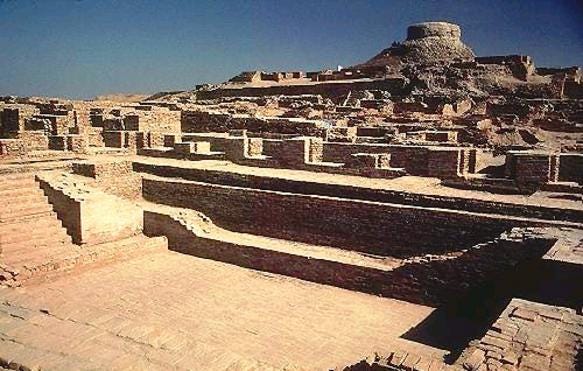
The most iconic representation of the Indus Valley’s water ingenuity is the Great Bath of Mohenjo-Daro. With dimensions measuring roughly 12 meters by 7 meters, and walls made of bricks coated in waterproof tar, the Great Bath was probably a public ritual bath. It was designed with an advanced water supply system, with channels bringing in fresh water and drains removing the wastewater, indicating a well-thought-out plan for water circulation.
Another fascinating aspect was the prevalence of domestic wells. Most houses in the larger cities had their own wells, providing ready access to clean water. This understanding of the importance of clean water at the household level, over four millennia ago, is awe-inspiring.
What is often under-emphasized is the communal responsibility that must have been involved in the maintenance of these systems. The drains would have required regular cleaning to remain functional, and the wells would have needed upkeep. There was no “Municipality or Public Works Department” as we know it today, so the community likely shouldered these tasks, pointing towards a societal commitment to managing water resources effectively.
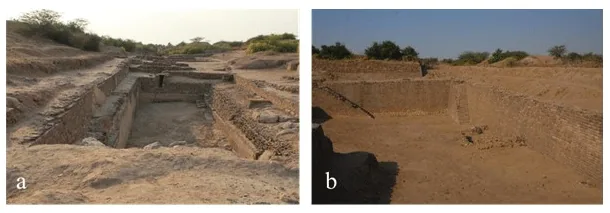
The Indus Valley people didn’t just take from nature; they harnessed it sustainably. For example, Dholavira, another site of this civilization located in present-day Gujarat, shows evidence of an intricate water conservation system that utilized rainwater harvesting. This was not merely an engineering task but a communal commitment to live harmoniously with the available natural resources.
The Ahar-Pyne System: The Watershed Wisdom of Magadha
Before the rise of empires and kingdoms that would shape India’s historical landscape, the region of Magadha (now part of modern-day Bihar) was setting benchmarks in sustainable water management with the Ahar-Pyne system. Dating back to as early as 500 BCE, this indigenous system was tailored to the unique topography and climate of the region.
The Dual Elements: Ahar and Pyne
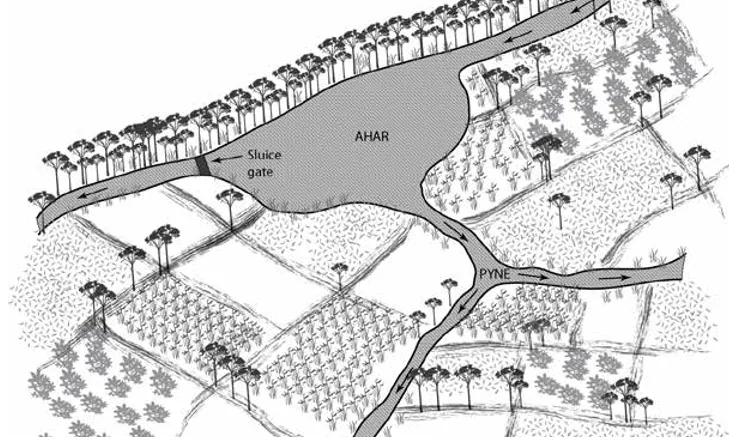
The Ahar-Pyne system is a two-part arrangement:
- **Ahar:**These are small, pond-like structures designed for storing water, mainly for agricultural purposes. They act as catchment basins for rainwater and help recharge the groundwater.
- **Pyne:**Pynes are artificial channels that divert water from rivers into the Ahars. They are constructed with meticulous planning to ensure that the flow is neither too weak nor too forceful, optimizing the water supply to the Ahars.
A striking feature of the Ahar-Pyne system was its reliance on community involvement. The Ahars were generally constructed near villages, and their maintenance was considered a communal responsibility. The villagers would often gather to desilt the Ahars and repair the Pynes before the onset of the monsoon season. This collective caretaking fostered a sense of ownership and responsibility, keeping the system functional and efficient.
The beauty of the Ahar-Pyne system lay in its synergy with nature. Rather than bending natural resources to fit human needs, the system adapted itself to the natural flow of water in the region. The Pynes followed the natural gradient of the land, ensuring efficient water flow without the need for additional energy.
Beyond its practical application, the Ahar-Pyne system was integrated into the social and cultural fabric of the community. It was more than just a water management technique; it was a way of life that deeply respected the interdependence of man and nature.
Baolis: The Underground Oasis of Rajasthan and Gujarat
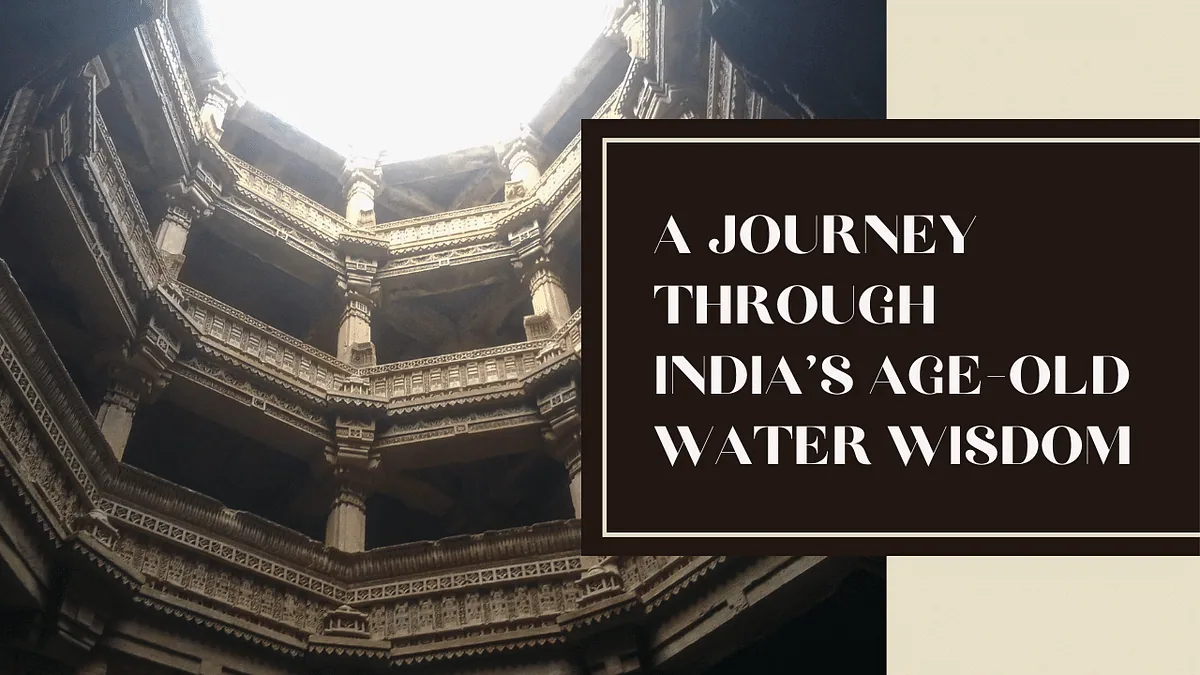
In the typically arid regions of Rajasthan and Gujarat, where water is a scarce commodity, ancient communities devised a unique solution: Baolis, or stepwells. Dating back to around 200 AD, these architectural wonders served as both water storage units and social hubs.
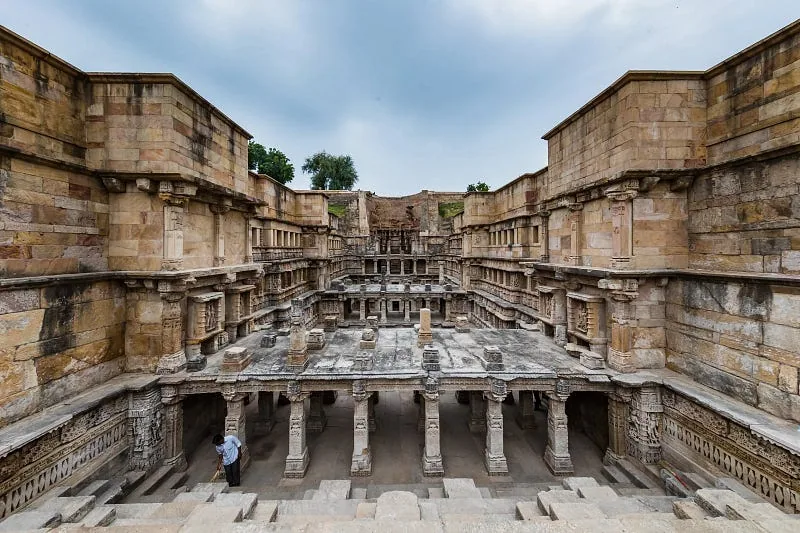
A typical Baoli consists of a vertical shaft from which water can be drawn, surrounded by a series of steps that descend down to the water level. Unlike a simple well where the primary function is just to draw water, Baolis were multi-functional. They served as cool sanctuaries during the hot summer months, meeting points for the community, and sometimes even housed temples.
The construction and maintenance of a Baoli were often funded by wealthy patrons, but the daily management, cleaning, and upkeep were responsibilities shared by the community. This shared sense of ownership not only ensured that the Baolis were well-maintained but also fostered social cohesion. Events, festivals, and even religious ceremonies were organized around Baolis, making them central to community life.
What makes Baolis truly extraordinary is the engineering acumen behind their construction. The steps were designed to minimize water loss due to evaporation, no small feat in the sweltering heat of these regions. The walls were often coated with lime mortar to prevent seepage, and the orientation was planned to keep out direct sunlight, thus preserving the water’s freshness for longer periods.
As remarkable as the engineering was, the social adaptability of Baolis is equally noteworthy. In some cases, they were connected to canals or natural catchment areas to keep them replenished. This was not a ‘one-size-fits-all’ model; each Baoli was adapted to the specific needs of its locality, exhibiting a level of customization that could only have been achieved through intimate local knowledge and community participation.
The Grand Anicut: Taming the Kaveri River with Chola Ingenuity
The Grand Anicut, also known as the Kallanai Dam, is a living testament to the hydro-engineering prowess of the Chola Dynasty. Built around the 2nd century AD and later enhanced in the 11th century, this ancient dam on the Kaveri River in Tamil Nadu stands as one of the world’s oldest water diversion structures still in use.
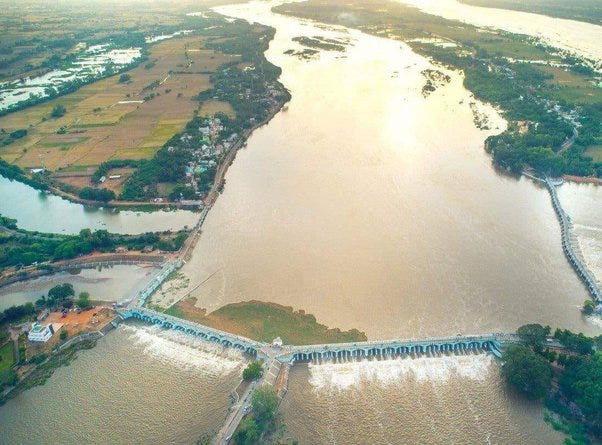
The Grand Anicut was built with the dual purpose of preventing the Kaveri River from spreading destructive floods over the delta region and storing and diverting water for irrigation. It ensured that a network of canals received a steady supply of water throughout the year, nourishing the fertile lands and fueling agriculture.
The dam was built using unhewn stones, stacked strategically to withstand the forces of water but without using any binding material. This design allowed the river to continue its natural sediment flow, reducing the risks of erosion downstream. Once again, this shows a delicate balance of using advanced engineering while respecting the natural processes of the river ecosystem.
In line with other ancient Indian water management systems, the Grand Anicut also relied on the collective efforts of the community. The dam itself may have been a royal project, but the channels and irrigation systems connected to it were very much a community affair. The responsibility for desilting canals, repairing banks, and ensuring equitable water distribution often fell upon the local population.
The effective water management facilitated by the Grand Anicut did more than just boost agriculture. It led to economic prosperity, population growth, and the development of arts and culture, transforming the Kaveri delta into one of the most vibrant regions of its time. In a way, the Grand Anicut was not just a dam; it was a catalyst that triggered a chain of societal advancements.
Phad Irrigation: The Community-driven Water Wheels of Maharashtra
Emerging in the 15th century in the state of Maharashtra, the Phad irrigation system stands as a testament to the adaptability and resilience of local communities in managing water resources. A Phad is essentially a block of arable land with a network of distribution channels, fed by diverting water from a river or stream. The core tenets of Phad irrigation are simplicity, efficiency, and, most importantly, community participation.
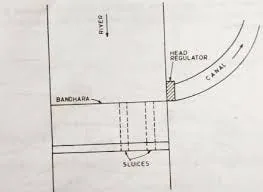
The basic engineering of Phad irrigation involves constructing temporary diversion structures made from locally available materials such as bamboo and mud. These barriers direct water flow towards individual Phads. To ensure equitable water distribution, intricate systems of sluice gates and channels are used, demonstrating a high level of expertise in hydraulic engineering.
What sets Phad Irrigation apart is its almost entirely community-driven approach. The planning, execution, and maintenance are communal responsibilities, often coordinated by a locally elected body or committee. Decisions about water distribution schedules, upkeep of the diversion structures, and dispute resolution are all community-led activities.
Despite being centuries old, Phad irrigation systems are not relics of the past but living traditions. Many are still operational, providing essential water supply for agriculture. This durability underscores not only the effectiveness of the initial design but also the ongoing community stewardship that keeps the system functional.
One of the most striking aspects of Phad irrigation is the ethical component. The community ensures equitable water distribution, prioritizing crops that require more water and adjusting sluice gates to serve the needs of individual plots. The system also minimizes water waste, embodying principles of ecological sustainability that are remarkably contemporary.
Ancient Wisdom for Modern Water Woes
As we look back at the intricate shades of India’s ancient water management systems, from the urban planning marvels of the Indus Valley Civilization to the communal farming systems enabled by Phad irrigation, we see not just feats of engineering or historical curiosities, but a reservoir of wisdom awaiting rediscovery.
A Common Thread: Community
Across different times and terrains, the role of the community stands out as a unifying thread. Whether it was the communal efforts in maintaining the Ahars and Pynes, the shared ownership in the upkeep of Baolis, or the locally-elected bodies that managed Phad systems, community involvement was the lifeblood that sustained these water management practices. This involvement went beyond mere labor; it instilled a sense of responsibility, a communal ethos of conservation that is glaringly absent in many of today’s large-scale, top-down water projects.
Local Solutions, Global Lessons
Each system was uniquely adapted to its local environment, whether it was the arid climate of Rajasthan or the river deltas of Tamil Nadu. These ancient systems underscore the importance of localized, context-specific solutions. They teach us that effective water management is about aligning with nature, not imposing upon it.
The Imperative of Reconnection
Today, we find ourselves grappling with a global water crisis, depleting aquifers, shrinking rivers, and rising demand. Modern technology alone will not solve these issues; we need a paradigm shift. We need to reconnect with our roots, to relearn the principles of conservation and community management that these ancient systems embodied.
Our Collective Responsibility
Finally, let’s come back to the idea that water management is not just the domain of governments or corporations: it’s every community’s responsibility. The legacy of India’s ancient water management systems offers not just inspiration but a clarion call. It’s a call to revisit our indigenous knowledge, to respect the wisdom of the past, and to reintegrate community-driven practices into our modern strategies for water conservation.
The water management systems of ancient India offer more than historical insights; they provide a roadmap. They remind us that the way forward often involves looking back, that solutions lie not just in futuristic technology but in age-old wisdom, and most importantly, that the sustainability of any natural resource is best assured when it is a shared responsibility.
That’s my learning for today!